Hello from Bucharest! or is it Budapest… Where am I? Oh well, the journey is more important than the destination they say, and my journey here was quite interesting, although the destination, Bucharest, is rather nice as well.
A bus from Chisinau takes 7-8 hours, the train takes 13. I took the train. It is also more expensive than the bus, but I was travelling first class. That’s correct, I booked a ticket for a first class berth on the overnight train from Chisinau to Bucharest, it was only $7 more than second class anyhow. Luckily I had read up on the journey beforehand, or I may have been somewhat shocked with what I discovered. The train has been described as a rolling Soviet museum, it appears relatively unchanged since the 50s or 60s. First class is not comfort class, but it was an experience. My cabin had two seats/beds. Nobody joined me on the journey. The train was a quarter full at most. The conductor is a gruff Moldovan man who speaks Russian.
Why does the train take so much longer than the bus? Well partly it’s because the train is very slow. Mostly it’s because they have to lift the train up. Train tracks in the former Soviet Union are a different size than those in the rest of Europe. This means that at the border with Romania they have to lift each carriage individually and change its wheels to fit the tracks. This, along with the border crossing, took about two hours, starting at about 7pm. If you take the train in the opposite direction you get woken up by immigration and customs at 3am.
The Moldovan customs officer poked through my bag and checked every possible storage spot in the cabin. Her Romanian counterpart said hi, asked if I had cigarettes or alcohol, and wished me a good journey. A middle aged Moldovan lady came by to ask if I was feeling well. I was.
While all this was going on the carriages were jacked up, and the new wheels installed. I watched the process happening to another carriage out of my window. I didn’t even feel when my own carriage was lifted or lowered. The experience was not all it was chalked up to be.
After that it was smooth sailing all the way to Bucharest. And when I say ‘smooth’ I mean ‘not smooth’. The train bumped along all through the night, and while my little bed was comfy enough, I’ve had better sleeps. That morning at 6am there was a knock on my door letting me know we were about to arrive, and just like that I was in Bucharest.
Many of the old buildings here were destroyed by Nicolae Ceaușescu, the Communist leader of Romania from ’65 to ’89, to make way for his massive building projects. One man saved over twenty buildings and churches by lifting them, installing train tracks underneath, and rolling them out of the way. This includes one apartment building which he moved with the residents still inside. There are still some nice buildings, especially ones from the turn of the century when French style was all the rage. The biggest attraction here is the biggest, literally.
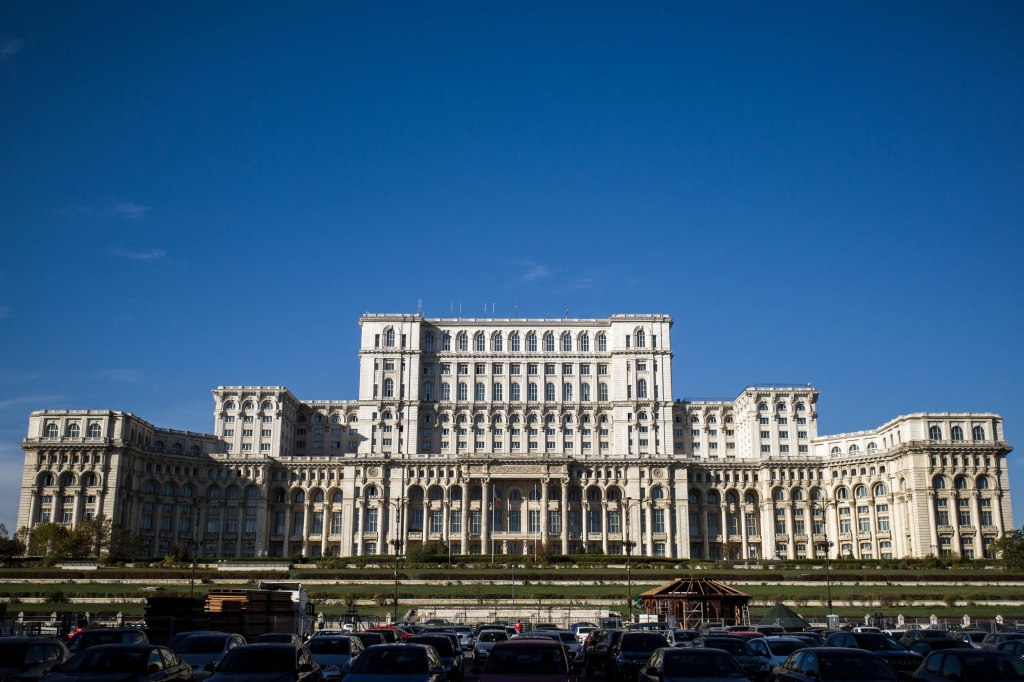
The Palace of the Parliament is the second largest administrative building in the world, after The Pentagon. It is also the heaviest building in the world, on account of all the marble, and carpets, and 16m high velvet curtains. Construction was started in 1983. Many of the best architects from Romania and worldwide submitted designs. Ceaușescu chose the design of a 27 year old straight out of school because hers was the largest, no other considerations. It was meant to take two years. When communism fell and Ceaușescu was executed in 1989 it was not complete. Since they had all the building materials ready to go they continued the project, finishing in 1996. There are over one thousand rooms inside. It currently houses the Romanian parliament, many government offices, a contemporary art museum, some restaurants, and other things. Less than 400 of the rooms are in use. You can rent them for conferences and other events.
As stupid as the building is, almost all of the building materials came from Romania, which is nice. There is marble everywhere, and expensive wood. The hundreds of chandeliers are made of crystal. If they turned on all the lights at once it would cause a power outage in Bucharest. The carpets are so large that they were made in pieces and stitched together once they were inside. I took a tour. We walked two kilometres (not in a straight line), and up 300 stairs, and saw only 5% of the building. I still struggle to grasp just how large it is. It is as big under the ground as above it, with a nuclear bunker at the bottom.
Ceaușescu wanted a massive balcony on the front so that he could give speeches to massive crowds of people. He died before the balcony was completed. The first person to speak from the balcony was Michael Jackson. He said, “It’s really good to be here in Budapest“. Many other international musicians have made this mistake. The second time Iron Maiden played Bucharest the road from the airport was lined with billboards saying, “You are in Bucharest, not Budapest”. Some tourists book a ticket to the wrong city. I was here on purpose.
I also visited Ceaușescu’s house. This was his private residence for him, his wife, and his three children. It was not as large as I expected, but I think that if I had not just been in the massive Palace of the Parliament I would have been more impressed. It was a pretty darn nice house.
I saw some other things in Bucharest, but these stood out.
 And whither then?