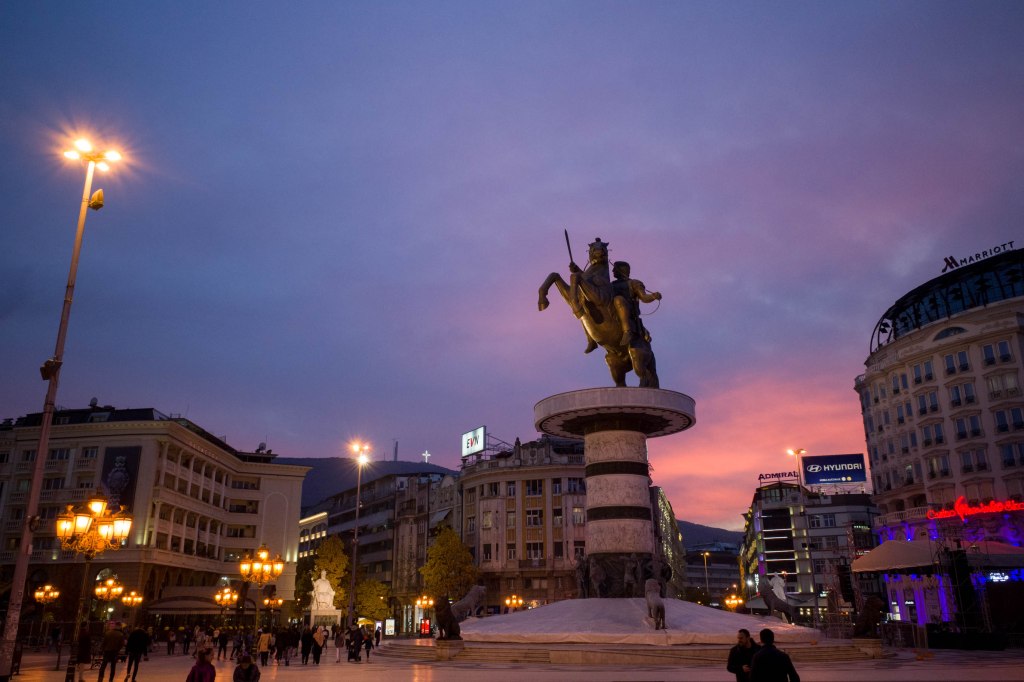
North Macedonia, the Republic formerly known as The Former Yugoslav Republic of Macedonia.
Skopje is the weirdest city I’ve ever visited. It may be the city with the most statues, it certainly feels like it. Highest density of statues at the very least.
When I arrived at night by bus I was greeted by a vision of a neon cross hovering high above the city.
“Is this it?”, I thought, “Is God finally revealing itself to me, proving my atheism to be a foolish mistake?”
In a word, no. The neon cross was a very man made item. It was the Millennium Cross, built to celebrate two millennia of Christianity, seated atop a mountain overlooking Skopje. It is the second largest cross in the world, the largest metal one.
As you walk along the river towards the centre of the city you will see many beautiful Baroque and classical style buildings. You will see uncountable statues of important Macedonians. You will see at least twice as many bridges as necessary.
Don’t be fooled. These beautiful old buildings and statues were mostly built between 2010 and 2014. They are built in styles that never existed in this area historically. When buildings like these were being built in other parts of Europe, Macedonia was part of the Ottoman Empire.
Skopje has been nearly completely destroyed three times by earthquakes in the last 1500 years, most recently in 1963. This is why there are very few real historical buildings in the city. The country and the city have also been very corrupt, which is why unthinkable amounts of money has been spent on statues and pretty buildings.
How does Dylan know all this? you wonder. Well, let me tell you. I’ve often been going on free walking tours of cities. It’s a good way to learn about the city, and figure out what you want to look more closely at during the rest of your time. These tours are generally pretty good. The one in Skopje is the best yet.
It didn’t hurt that only three of us turned up for the tour. This made for a more intimate, personal tour than you usually get. We were outnumbered by the stray dogs that followed us along our way. They had tags indicating that they had received shots and been fixed, so they were very friendly and not aggressive. Unless you’re on a bicycle, that is. As we walked the streets of Skopje our posse of dogs kept us very safe from cyclists, barking and biting at ankles, as well as chasing any car that dared to drive by.
So we had pets and protection, good start. We also had an excellent tour guide. Mihal was the friendliest, most welcoming guide one could hope for. Our tour went much longer than usual because we were talking for so long. Mihal brought us to a restaurant and treated us to rakia, Balkan alcohol made from plums, grapes, or other fruit. He said we’d take a 20 minute break there. We ended up staying for an hour and twenty minutes. Of course stopping there is just part of his standard tour, but getting an in-depth, fairly unbiased, explanation of the issues around the name Macedonia, was a bonus.
Also as part of the tour we got a coupon for free rakia, and one for free beer. Although the value of such things was $3 max. But I drank well that day.
Anyhow, back to the statues. There’s a massive equestrian statue of Alexander the Great, but it’s officially called “Man on Horse” or something, so as not to bother the Greeks who think they own Alexander and the name Macedonia. There is a fountain with four statues of Alexander’s mother in it. There is a statue of his father. There are two bridges with about 30 statues on each of them. There are countless other statues. There is a triumphal arch, even though Macedonia has had no military triumphs in the last 2000 years.
Even knowing none of the story behind how silly all these things are, it still feels pretty absurd. When I first walked into the centre I was thinking “what the heck”, at every turn.
There are a handful of actual historical buildings still remaining in the city. One famous bridge, the large fortress, and many buildings and streets in the Old Bazaar area.
The Old Bazaar is windy cobblestone streets with shops and restaurants crammed into every available space. Apparently restaurants don’t have to pay taxes in the bazaar if they keep their building in its original condition, so prices are very cheap. It’s the perfect place to sit outside sipping a glass of Turkish tea or rakia, as the mood takes you, and watching the bustle of people.
Some fun facts about Skopje. Mother Teresa was born here. After the 1963 earthquake, because Yugoslavia had relations with both the USSR and America, relief was sent from both countries to Skopje. As a result, American and Soviet soldiers shook hands for the first time since the Cold War began.
All of the city’s buses were destroyed when their garage collapsed in the earthquake. So London sent some of its double-decker buses to help out until Skopje replaced their fleet. Now, in the last few years, Skopje’s newest buses are double-decker and built in a retro style to look somewhat like London’s buses of the 60s.
I highly recommend Skopje. You’ll never see another city like it.
 And whither then?