It was an eight hour bus ride from Budapest to Cluj, half of it in the dark. I saw very little of the Romanian countryside on account of this, which is a shame. I was especially sad for the darkness because the roads we drove once in Romania felt quite exciting. We drove downhill for quite some time on a narrow, winding road full of switchbacks and tight corners. I suppose the darkness added to the excitement of the drive, as all I could really see were the headlights of oncoming traffic.
And then I arrived in Cluj-Napoca, Cluj for short, largest city in a certain region of Romania you may have heard of before, Transylvania… Ever since arriving I must admit I find myself less sanguine than usual. I feel somewhat drained. I awaken in the morning feeling weak and somewhat faint. I shy away from the sun…
I only kid. I feel just fine and there are absolutely no vampires here. I cannot stress enough the fact that everything is normal.
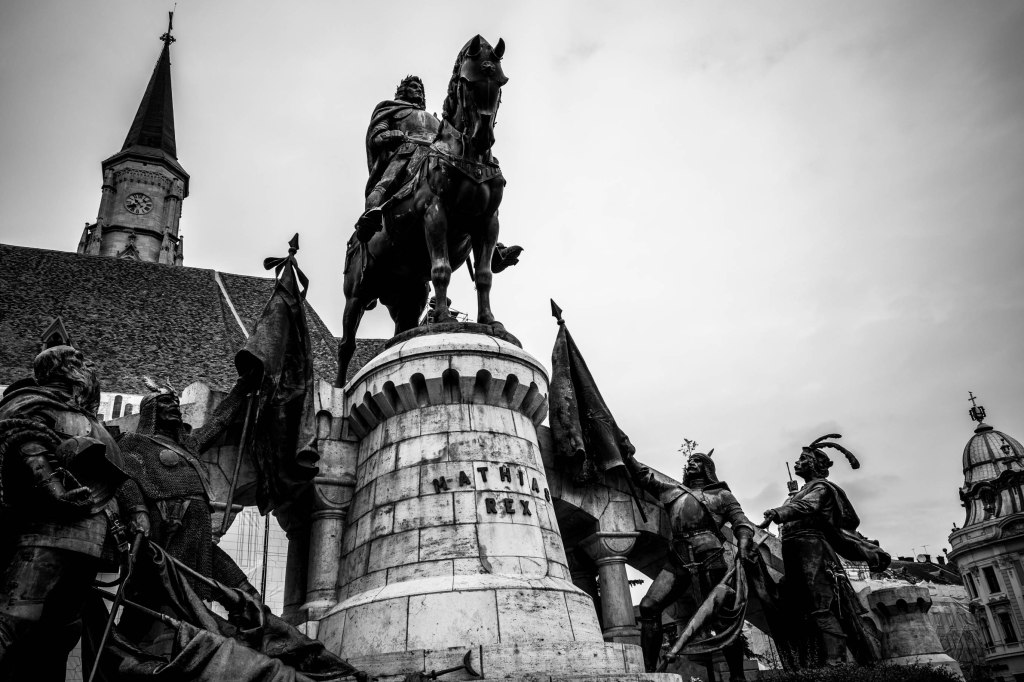
Cluj was under construction, or renovation I suppose. The cathedral was shrouded in cloth, another large church was infested with scaffolding, and the purportedly stunning ‘mirror street’ in which both sides of a street are identical, is somewhat lopsided with one half being refurbished. It was an interesting city to spend some time in nonetheless. Fairly quiet, good coffee, small streets and wide avenues. I spent an afternoon walking in a park on a hill, trying not to trip on the decaying concrete paths and steps. There were a couple dozen strange concrete cylinders jutting out of the ground on a hillside. They extended about half a meter above the ground, and since many were missing their tops, I could see that metal rungs set in to the walls allowed you to climb several meters beneath the surface, not that you’d want to with all the empty bottles people have thrown in them. Perhaps the cylinders were once sarcophagi for the vampires which used to roam this land. I do not know the answers.
I ate a rather interesting food here, from an etymological point of view. Plăcintă is a disk of dough filled with cheese, potato, or cottage cheese. They were available from the windows of little shops for about one dollar and were rather tasty. The name plăcintă comes from the Latin placenta, meaning cake. You may also associate placenta with something else that is not a cake. However, it would seem that the term placenta in English got its meaning because it resembles, in shape if not in colour, a flat, disk-like cake such as a plăcintă. There’s your fun fact for the day, now go away.
 And whither then?
“infested with scaffolding”…that’s nice writing 🙂
Inspires me to write something creative.
No vampire museums?
LikeLike
Dylan your posts are great. Following them religiously. Granpa
LikeLike