I spent a whole week in Minsk, which was a very welcome change of pace after spending several weeks changing location every couple of days. It was also because I had to fly to get here rather than taking the train or bus, so I wanted my flight to count for something. Canadians need a visa to enter Belarus, unless you fly in and out via Minsk. I really would have preferred to take a train in and out, but the visa process was long and nearly as expensive as flying, so I took the easy route. Besides, it was only a 35 minute flight from Vilnius on the Belarusian airline Belavia, which was quite good, and certainly much more comfortable than a certain Canadian airline that I “Transat-ed” to Europe with…
Entering the country was a very simple process, it was smoother than when I arrived in Stockholm from Canada. There I was asked where I was staying, and where I was going next, and the officer asked to see my ticket for the concert I said I came for. In Minsk, the immigration officer, dressed in a very soviet looking uniform, asked if I was staying in Minsk, looked through my passport, and then stamped it. In customs I had nothing to declare, and I saw no one to declare anything to, so I walked right through. Simple. And I was in Belarus.
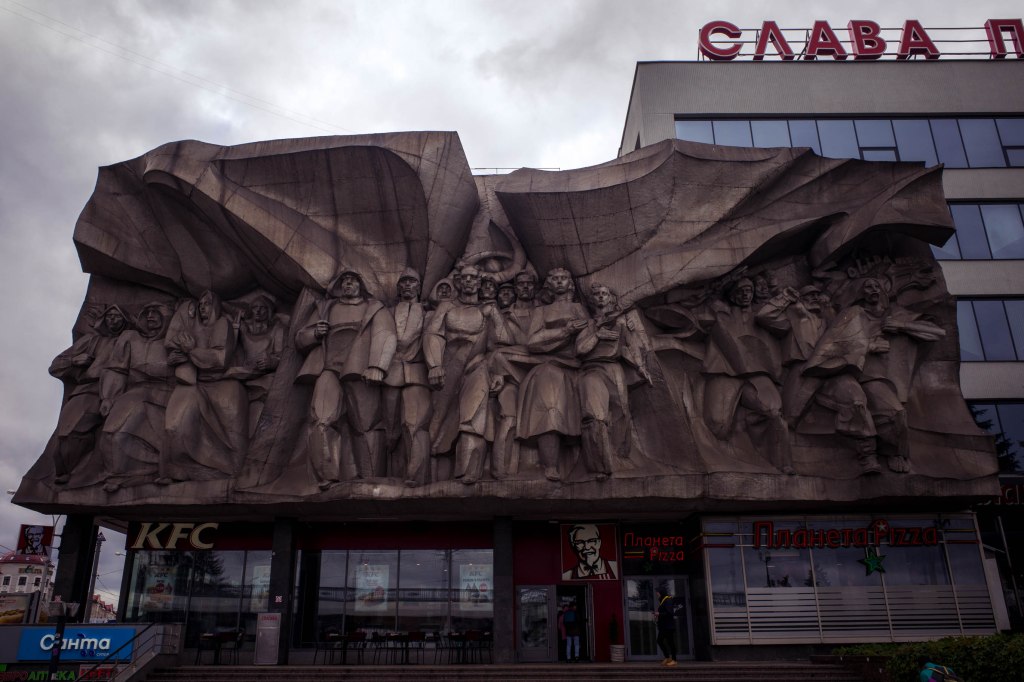
Minsk is no different from any other city. Except that there is Soviet architecture everywhere, and you don’t have to look very hard to find a hammer and sickle or a statue of Lenin. But there is McDonald’s and KFC and people go about their lives just like anywhere else. One thing that surprised me was the number of American cars I saw. In Finland an the Baltic countries I barely noticed a single American car, but in Minsk there were suddenly some Fords driving around, which struck me as odd for a country that has been somewhat isolated from the West.
Most of the city was destroyed during WWII, and Belarus lost a third of its population in the war. So a majority of the buildings are from the soviet era or newer. There are a handful of 19th century buildings that survived or were recreated, and they are quite nice as well. I learned a lot about Belarus’s role in the second world war at the Museum of the Great Patriotic War. This is an incredible building which is a massive monument to the war as well as a museum. The exhibition displays weapons and vehicles from the war, but the majority of it is pictures of hundreds of Belarusians who fought in the war alongside some of their personal effects. Many of these were medals, but also cameras, books, daggers, and even spoons for some reason.
The National Art Museum was a perfectly good art museum, primarily featuring art from Belarus from the middle ages to the present. The Cat Museum is like a cat cafe where you can hang out with cats for a while, but this was done up like a museum with famous pieces of art featuring cats on the walls. Without doubt the best museum I saw on my trip was the Museum of Money. It’s small, just two rooms. I’ve seen plenty of coins in museums before, and although I find coins interesting, they don’t tend to capture me in a museum setting. What made the Museum of Money great was the employees. For the very low price of admission, I got a tour of the exhibit, in English, by a very passionate and knowledgeable guide. I now know more than I ever expected to about the history of money in what is now Belarus, as well as some interesting facts about the international currency they have. You’ll see some of that in the photos.
That tour was in English, but people speaking English was far from the norm. Belarus is the first country I’ve visited where getting by with only English and a couple of words in the local language was barely enough. I survived, but before I return I’d like to actually learn some Russian. Nevertheless, everyone I interacted with was friendly and helpful. On the free walking tour I learned that Belarusians pride themselves on being helpful and hospitable, but I’d already experienced that.
I spent a lot of my time in Minsk wandering around, enjoying the soviet architecture, and the large parks. One industrial area has been transformed with massive murals. I walked to the National Library of Belarus which is a pretty incredible building built in the shape of a rhombicuboctahedron. You know, everyone’s favourite architectural shape, the rhombicuboctahedron.
I also spent a lot of time eating. Belarus has some good food. They really like potatoes here. I ate quite a few draniki, which are potato pancakes, sometimes stuffed with meat. And I ate quite a lot of meat in general. I ate Uzbek food for the first time, which was a nice change of pace after all the very lightly seasoned Baltic and Belarusian food I’d been eating. I’d forgotten what spices tasted like. They make a good rice pilaf, and also horse sausage, strongly spiced with cumin. I also drank a lot of coffee, and good coffee too. There are many top notch coffee shops in Minsk which would not be out of place in Canada or Australia. Each time I walked into one I could have been in any big, western city.
And to top it all off, I went to the Opera. For the low price of $8 Canadian I got a pretty good seat for a performance of Salome by Richard Strauss. It was alright. The Opera house is an amazing soviet building. The set design and costumes were excellent. They went for an anachronistic feel, which reminded me of Jesus Christ Superstar, and slightly campy costumes, which also reminded me of JCS. Unfortunately, the singing was not great. I could barely hear most of the male singers. The women, especially the lead were pretty good, but I couldn’t understand anything regardless because they were singing in German and the handy-dandy subtitle things were in Russian.
I did some other things in Minsk, but a week is quite a while. So I will end here.
 And whither then?