Bang! Bang! Bang!
I’m walking down the street in an unrecognized country in Eastern Europe. It is night time.
Eight hours earlier I was boarding a minibus in Chisinau, capital of Moldova. Minibuses, or marshrutkas as they are called in Russian, are a very common form of transport in this area of the world. It’s like a large van, seating about 15-20 passengers. My minibus goes to Tiraspol, capital of the unrecognized republic of Transnistria (Pridnestrovie in Russian).
Moldova was a part of the Soviet Union. With the collapse of the USSR, the Moldovans, who are primarily of a similar ethnicity and culture to Romania, began to set up their own country. In the east of Moldova, across the Dniester river, the ethnically Russian population were not happy about this, so they formed their own country, Transnistria.
A short war later and they were still part of Moldova. Since then they have operated as their own independent country. Although Moldova considers Transnistria to be part of itself, they have essentially let the state be. Transnistria has its own government, currency, and even passports (although most citizens have Moldovan or Russian citizenship as well). No countries recognize Transnistria. Three other unrecognized countries recognize Transnistria. Abkhazia, South Ossetia, and Artsakh. Despite its status, and unlike other unrecognized countries, Transnistria has been conflict free for years, making it an ideal destination to travel if you want to get off the map a bit.
As I waited for my minibus to leave the station, who should arrive but two other travellers who were at the same hostel as me in Chișinău, and would be staying at the same hostel in Tiraspol. Hearing us speaking English, a lady on the bus strikes up a conversation. Her English is excellent. She works in Chișinău and is returning home to Tiraspol for the weekend.
The bus sets out. I’ve mentioned already that the roads in Moldova are bumpy. Most of the journey is on a two-lane road. Traffic generally drives half in the lane and half in the shoulder, allowing cars to pass down the centre line regardless of oncoming traffic. Some of the journey is on a three-lane road where the centre lane is seemingly reserved for passing in both directions. It’s exhilarating.
We arrive at the border. Most of the passengers on the bus must be Transnistrian because they don’t have to do anything. Us foreigners get off the bus and head into the tiny immigration office. Our new Transnistrian friend comes along and speaks to the officer in Russian for us. There are no problems. It would have been fine without her help, but a few years ago we likely would have had to navigate bribes and poor communication. They don’t stamp your passport here. Instead, you get a slip of paper with your details to keep with you until you leave. We have arrived in Transnistria.
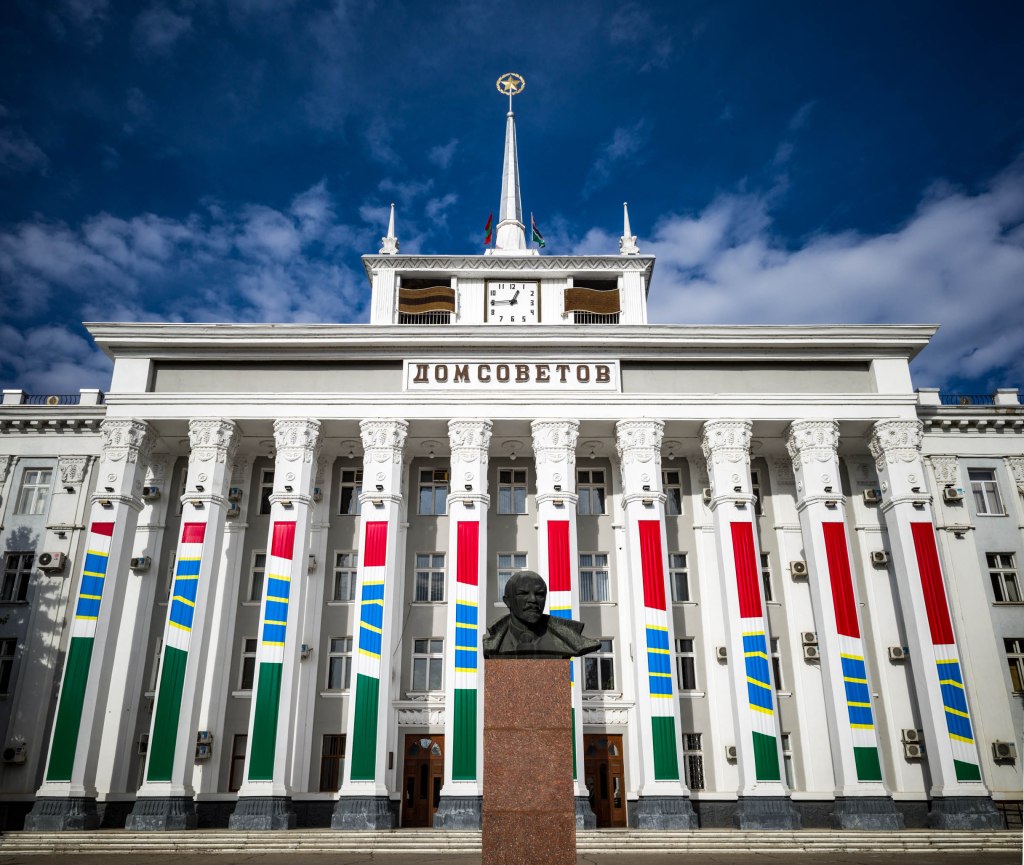
Immediately after crossing the border the roads improved. I guess Transnistria is putting the money they receive from Russia to good use, while in Moldova who knows where the tax dollars go. That being said, the capital Tiraspol is fairly similar to Chișinău. Slightly better sidewalks, and more statues of Lenin being the main differences. Oh, and it’s very quiet. There isn’t much to do here.
Upon arrival, we exchange our Moldovan Lei for Transnistrian Rubles. The currencies have very similar values, but the Ruble is worthless outside of Transnistria. You can only exchange it back to real money while in Transnistria. You can’t pay by card anywhere in the country.
Our hostel in Tiraspol, one of three available, is fantastic. There are three other travellers already there, and when we arrive the owner has just finished making borscht. Maybe it was special for Saturday night, free breakfast is also included.
Oh yeah! The cliff-hanger from the beginning of my story…
Bang! Bang! Bang!
We’re walking along the main street that night when we hear these sounds from the building next to us. We look over to see fireworks exploding above the roof of the building. Maybe November 2nd is a special day? I think someone was just setting them off for fun.
We’re heading to a pub, we think. There aren’t many options here. It’s called Bro Beer Burger. It’s pretty upbeat. There are many young people here. One group of young men (I later learned they were 16-year-olds), realize we are foreigners and immediately welcome us. They’re excited and amazed that anyone is visiting their country. A beer is $1. A boy who looks younger than 16 buys us shots of vodka.
I had a decent conversation with one of the guys who spoke fairly good English. He’s not so happy with the country since there’s little to do and few opportunities. His family wants to move to America. The others don’t know much English, but at every opportunity they say “thank you for coming here”, and “we love you”. We end up at a club. It was a half-decent club I think… I really wouldn’t know. I’m uncomfortable enough at a club in Canada, so a club in Transnistria was really not my scene. I left before the others.
The next day I walked around the city. There’s an old amusement park. It’s still operating. Looks like a good way to injure yourself. There are some old Soviet buildings. Two statues of Lenin. A couple other sights. Not too much. A meal with a glass of Transnistrian wine is $5. Tiraspol has the Kvint factory. They make what is supposedly the best brandy in Eastern Europe, as well as wine and vodka. A bottle of vodka is as little as $1. The tourist information centre, which doubles as the country’s only souvenir shop is closed while moving locations, so my only souvenirs from the country that doesn’t exist are some worthless money and my immigration paper, which is printed on receipt paper.
I have been to many places, and have many more to see, but Transnistria will always be one of the most unique.
 And whither then?