It was an eight hour bus ride from Budapest to Cluj, half of it in the dark. I saw very little of the Romanian countryside on account of this, which is a shame. I was especially sad for the darkness because the roads we drove once in Romania felt quite exciting. We drove downhill for quite some time on a narrow, winding road full of switchbacks and tight corners. I suppose the darkness added to the excitement of the drive, as all I could really see were the headlights of oncoming traffic.
And then I arrived in Cluj-Napoca, Cluj for short, largest city in a certain region of Romania you may have heard of before, Transylvania… Ever since arriving I must admit I find myself less sanguine than usual. I feel somewhat drained. I awaken in the morning feeling weak and somewhat faint. I shy away from the sun…
I only kid. I feel just fine and there are absolutely no vampires here. I cannot stress enough the fact that everything is normal.
Cluj was under construction, or renovation I suppose. The cathedral was shrouded in cloth, another large church was infested with scaffolding, and the purportedly stunning ‘mirror street’ in which both sides of a street are identical, is somewhat lopsided with one half being refurbished. It was an interesting city to spend some time in nonetheless. Fairly quiet, good coffee, small streets and wide avenues. I spent an afternoon walking in a park on a hill, trying not to trip on the decaying concrete paths and steps. There were a couple dozen strange concrete cylinders jutting out of the ground on a hillside. They extended about half a meter above the ground, and since many were missing their tops, I could see that metal rungs set in to the walls allowed you to climb several meters beneath the surface, not that you’d want to with all the empty bottles people have thrown in them. Perhaps the cylinders were once sarcophagi for the vampires which used to roam this land. I do not know the answers.
I ate a rather interesting food here, from an etymological point of view. Plăcintă is a disk of dough filled with cheese, potato, or cottage cheese. They were available from the windows of little shops for about one dollar and were rather tasty. The name plăcintă comes from the Latin placenta, meaning cake. You may also associate placenta with something else that is not a cake. However, it would seem that the term placenta in English got its meaning because it resembles, in shape if not in colour, a flat, disk-like cake such as a plăcintă. There’s your fun fact for the day, now go away.
Budapest is great at night. It’s a very safe city, but the street lights are so dim that you feel like you’re in the deep dark bowels of a dangerous metropolis. Very atmospheric.
It’s also great during the day. You may recall that I disliked Prague for being too busy. Budapest is also quite busy, but it feels like a real city for people to live in, and not like a massive tourist theme park. It may help that the big sights are a bit more spread out, so its tourists aren’t all jammed quite so close together.
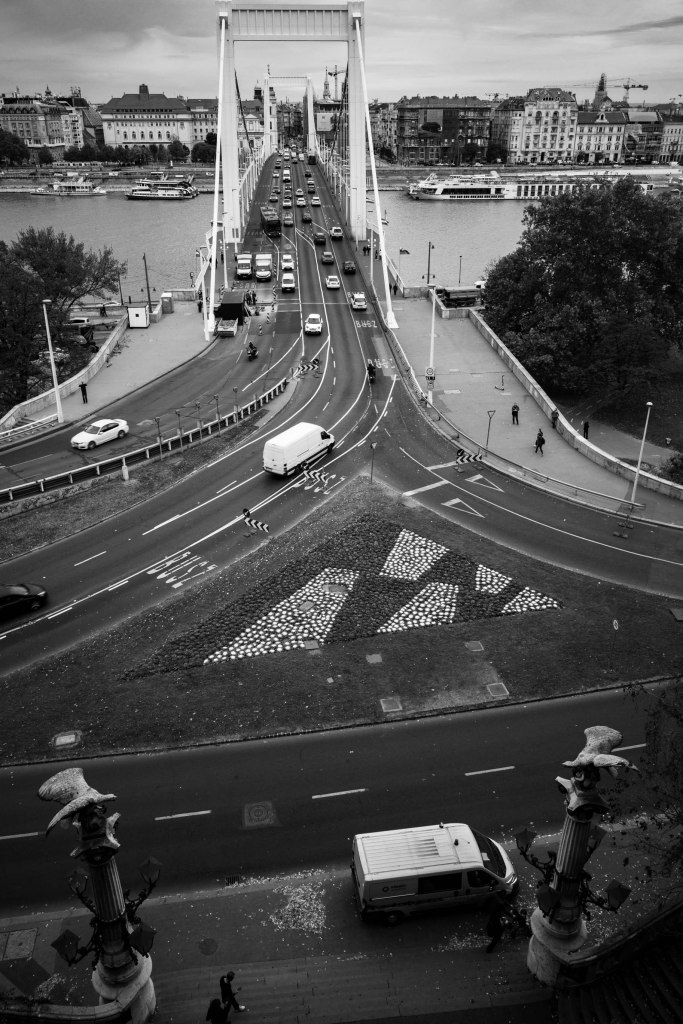
There’s lots to see in Budapest. You could spend an entire day just wandering around the castle district atop its hill on the Buda side of the river (Budapest used to be two cities named Buda and Pest, on either side of the Danube). There are ruined castle walls, a palace, churches, and a beautiful view of the Pest side of the river. Near the castle is an even larger hill, a forested park, with the massive freedom monument commanding the city from its summit, a woman holding a feather gazing across the city. It’s a good walk to get up there.
I found a pinball museum, and took a break from the busy city to refresh my senses with a series of rooms filled with over one hundred pinball machines, all of which were playable. Of course they weren’t all being played at once, but it was a noisy place, and a fun place. I’m not much good at pinball, I don’t have much practice, but it sure is entertaining. It was nice to do something outside of the ordinary travelling experience.
I haven’t talked about food in a few posts. Czechia and Slovakia didn’t have bad food, but it wasn’t anything to write about. Hungary on the other hand, has very good food, and very good prices. You may have heard of goulash, it’s very tasty. Chicken paprikas is chicken in a creamy paprika sauce, served with funny little noodles. Or you can have it with palacsinta, which are basically crepes, which of course you can also have for dessert with chocolate or jam. All delicious, all affordable. You can get a meal with a beer for $8 Canadian or under, including a tip.
Speaking of tipping, up until Czechia tipping wasn’t a thing in the countries I visited. These last few countries however, a 10% tip is the polite thing to do. It’s tricky though. If you’re paying by card you have to tell your server how much to charge you. Debit machines don’t have a function like in Canada where it asks you how much you want to tip and you punch in an amount or a percentage. So you look at the bill, figure out 10%, add it to your total, and ask the server to charge that much. Except that for some reason the servers always enter your total into the machine the moment they give you the bill, as if they don’t want a tip, and I feel rude saying, “no no, cancel that and charge me this much please”, so mostly I’ve been tipping with spare change.
Well there you have it, an all too brief stop in Hungary and I’m off again. Szia!
I don’t recommend night buses. I took one so that you don’t have to. Fifteen and a half hours from Vilnius to Kraków, Poland. 11:00pm to whenever the heck I arrived the next day. I severely overestimated my ability to sleep on a bus. Every other bus journey I’ve taken during the day I’ve been nodding off and fighting to not fall asleep and miss my stop. As soon as I had to sleep on a bus however… there was absolutely no chance of it. I think I got maybe an hour over the night. Awful.
Why such a stupid bus ride? I’m not sure. I wanted to get to Kraków and this was a way to do it. The thing about Poland is that it’s quite a large country by European standards, and I wasn’t entirely sure what I wanted to see while there. My main interests are in the countries south of Poland, so Poland is just kind of in the way. Plus I set myself a deadline since there’s a concert I want to attend in Prague. So I skipped over most of Poland and came to Kraków, primarily for a certain infamous nearby attraction, which will receive its own post.
I had two and a half days in Kraków, one of which would be taken up by aforementioned infamy. If you ask the internet what to do in Kraków, drinking is recommended. There are a lot of bars here. I’m not in Europe to party my way across the continent, so I was leery of this suggested activity. However, it was a Saturday night, and a couple of Brits in my hostel room roped me and an American into a bit of a pub crawl, and we had a very good time.
Our hostel was right next to the Jewish district of the city, which is a very nice area with a bit of a gritty, grimy vibe to it. One of the Brits had researched the best bars in the area, so he led us through a selection of very nifty bars, all within approximately two minutes walking distance from each other. The bars all had very good atmosphere and were much more interesting than your average drinking establishment. One, called Singer, lived up to its name by using Singer sewing machines for every table. Two bars in particular stood out. One was a Communist themed bar. Inside was dark and dingy, a portrait of Lenin gazed down from the wall, you could smoke inside even though its not legal in Poland. There was also a secret bar, the entrance of which was at the back of an “out of order” toilet in another bar. This was super cool not only because it felt exclusive, but also due to the drink menu. Each cocktail they had available was represented by a piece of art by a local artist, with no ingredients listed. You simply picked the art that stood out to you and received the corresponding cocktail. Very cool.
I also ate some food whilst in Krakow. Pierogies of course, which are incredibly budget friendly and delicious. Kielbasa and blood sausage from a street vendor, both delicious. And a popular pretzel which was big and bready.
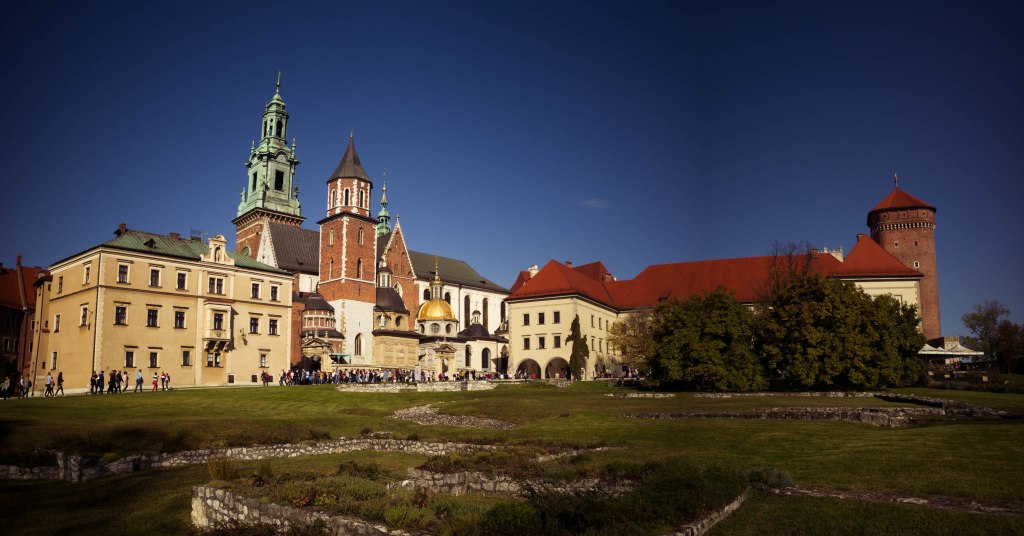
I barely took any pictures while here, but I saw some neat things. The aforementioned Jewish district was very nice. The old town was quite magnificent, and there was a lot going on. At 13:00 somebody played a trumpet from the top of a church tower. Then, a children’s marching band played Sweet Caroline in the main square. At the palace I saw something I never thought I’d see in my life, and probably never will again. Dragon Bones. They were incredible. Massive, unbelievable bones hanging outside of the cathedral at the palace. They belonged to a dragon that used to live in a cave beneath the palace. Naturally, I was skeptical at first, but having seen the bones I can only conclude that they must belong to a dragon. No other animal could possibly have such large bones.*
I’m currently on a train to Prague to see a concert tonight, and I guess the city might be worth looking around. Keep an eye out for my next post which will be about Auschwitz, although I’m not sure what to write about such a place.
Oh! I almost forgot to mention. In the Baltics the temperature was getting down to about 10°, and it was grey and a bit rainy, and in Belarus it even hit 0° on one day. But I arrived in Krakow to 20° weather and sunshine, so things are looking good.
Vilnius is pretty cool. It’s the first city on my trip that begins to feel like what I imagine Prague and Budapest to feel like (I’ll be in those cities soon and no longer have to imagine). Everywhere you look there are church spires, red terracotta roof tiles stretch out before you, and everything is rather nice. Not that every city I’ve been to so far hasn’t been beautiful, they’ve just been less grand.
It makes sense that Vilnius would be nice. It was only the capital of the Grand Duchy of Lithuania, which for a time was the largest state in Europe, encompassing Lithuania and much of Poland and Belarus.
Vilnius Cathedral is the most unique church I’ve seen thus far. It’s built in a classical style and wouldn’t be too out of place in the Mediterranean. I highly recommend taking a tour of the crypts, it’s inexpensive, it’s the only way you can see them, and my tour guide was excellent.
I might not recommend the Museum of Genocide/KGB Museum. It is similar in content to the Museum of Occupation in Tallinn, but not as well presented. The content is good. Lithuania had a very active resistance to soviet rule, first armed and then peaceful; and the KGB prison in the basement is evocative (although again, Tallinn was better… sorry Vilnius), but the information was not very well presented and I found myself growing bored with what should have been interesting material.
Also like Tallinn, Vilnius has an abandoned soviet sport arena, The Palace of Concerts and Sports. It is some top notch soviet architecture, and abandonment and graffiti only makes it more evocative.
There are a lot of good, very modern feeling restaurants in Vilnius. Places with slick interior design and aesthetic menus. Also the food is good. I even went to a vegan restaurant since I’ve been eating mostly meat and potatoes and maybe not enough vegetables for the last month. And it has been one month since I arrived in Europe. Time flies.
The absolute best thing I discovered in Vilnius was a coffee shop. Crooked Nose & Coffee Stories is a micro roastery and coffee shop. The owner roasts very small batches of beans, and only brews them using manual drip methods. There’s the standard Aeropress and Chemex, but also traditional Japanese Nel drip, and a method he developed himself called Bro. Needless to say, I loved it there. The owner (whose name I should have learned) was very friendly and happy to talk about coffee, and the coffee was good. He had beans from Yemen, which I have never experienced before. They come from a British-Yemeni company that works with growers in Yemen to improve their crops and export to the world. It was a rich coffee with notes of dried blueberries, cocoa, and an earthy quality. Good stuff!
I spent a whole week in Minsk, which was a very welcome change of pace after spending several weeks changing location every couple of days. It was also because I had to fly to get here rather than taking the train or bus, so I wanted my flight to count for something. Canadians need a visa to enter Belarus, unless you fly in and out via Minsk. I really would have preferred to take a train in and out, but the visa process was long and nearly as expensive as flying, so I took the easy route. Besides, it was only a 35 minute flight from Vilnius on the Belarusian airline Belavia, which was quite good, and certainly much more comfortable than a certain Canadian airline that I “Transat-ed” to Europe with…
Entering the country was a very simple process, it was smoother than when I arrived in Stockholm from Canada. There I was asked where I was staying, and where I was going next, and the officer asked to see my ticket for the concert I said I came for. In Minsk, the immigration officer, dressed in a very soviet looking uniform, asked if I was staying in Minsk, looked through my passport, and then stamped it. In customs I had nothing to declare, and I saw no one to declare anything to, so I walked right through. Simple. And I was in Belarus.
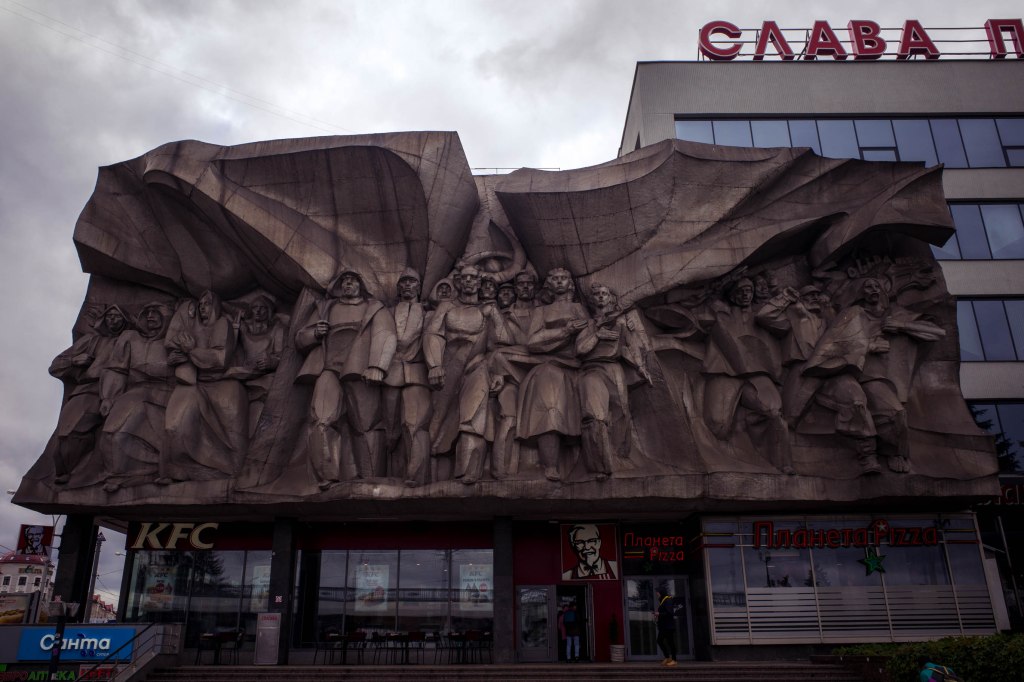
Minsk is no different from any other city. Except that there is Soviet architecture everywhere, and you don’t have to look very hard to find a hammer and sickle or a statue of Lenin. But there is McDonald’s and KFC and people go about their lives just like anywhere else. One thing that surprised me was the number of American cars I saw. In Finland an the Baltic countries I barely noticed a single American car, but in Minsk there were suddenly some Fords driving around, which struck me as odd for a country that has been somewhat isolated from the West.
Most of the city was destroyed during WWII, and Belarus lost a third of its population in the war. So a majority of the buildings are from the soviet era or newer. There are a handful of 19th century buildings that survived or were recreated, and they are quite nice as well. I learned a lot about Belarus’s role in the second world war at the Museum of the Great Patriotic War. This is an incredible building which is a massive monument to the war as well as a museum. The exhibition displays weapons and vehicles from the war, but the majority of it is pictures of hundreds of Belarusians who fought in the war alongside some of their personal effects. Many of these were medals, but also cameras, books, daggers, and even spoons for some reason.
The National Art Museum was a perfectly good art museum, primarily featuring art from Belarus from the middle ages to the present. The Cat Museum is like a cat cafe where you can hang out with cats for a while, but this was done up like a museum with famous pieces of art featuring cats on the walls. Without doubt the best museum I saw on my trip was the Museum of Money. It’s small, just two rooms. I’ve seen plenty of coins in museums before, and although I find coins interesting, they don’t tend to capture me in a museum setting. What made the Museum of Money great was the employees. For the very low price of admission, I got a tour of the exhibit, in English, by a very passionate and knowledgeable guide. I now know more than I ever expected to about the history of money in what is now Belarus, as well as some interesting facts about the international currency they have. You’ll see some of that in the photos.
That tour was in English, but people speaking English was far from the norm. Belarus is the first country I’ve visited where getting by with only English and a couple of words in the local language was barely enough. I survived, but before I return I’d like to actually learn some Russian. Nevertheless, everyone I interacted with was friendly and helpful. On the free walking tour I learned that Belarusians pride themselves on being helpful and hospitable, but I’d already experienced that.
I spent a lot of my time in Minsk wandering around, enjoying the soviet architecture, and the large parks. One industrial area has been transformed with massive murals. I walked to the National Library of Belarus which is a pretty incredible building built in the shape of a rhombicuboctahedron. You know, everyone’s favourite architectural shape, the rhombicuboctahedron.
I also spent a lot of time eating. Belarus has some good food. They really like potatoes here. I ate quite a few draniki, which are potato pancakes, sometimes stuffed with meat. And I ate quite a lot of meat in general. I ate Uzbek food for the first time, which was a nice change of pace after all the very lightly seasoned Baltic and Belarusian food I’d been eating. I’d forgotten what spices tasted like. They make a good rice pilaf, and also horse sausage, strongly spiced with cumin. I also drank a lot of coffee, and good coffee too. There are many top notch coffee shops in Minsk which would not be out of place in Canada or Australia. Each time I walked into one I could have been in any big, western city.
And to top it all off, I went to the Opera. For the low price of $8 Canadian I got a pretty good seat for a performance of Salome by Richard Strauss. It was alright. The Opera house is an amazing soviet building. The set design and costumes were excellent. They went for an anachronistic feel, which reminded me of Jesus Christ Superstar, and slightly campy costumes, which also reminded me of JCS. Unfortunately, the singing was not great. I could barely hear most of the male singers. The women, especially the lead were pretty good, but I couldn’t understand anything regardless because they were singing in German and the handy-dandy subtitle things were in Russian.
I did some other things in Minsk, but a week is quite a while. So I will end here.
 And whither then?