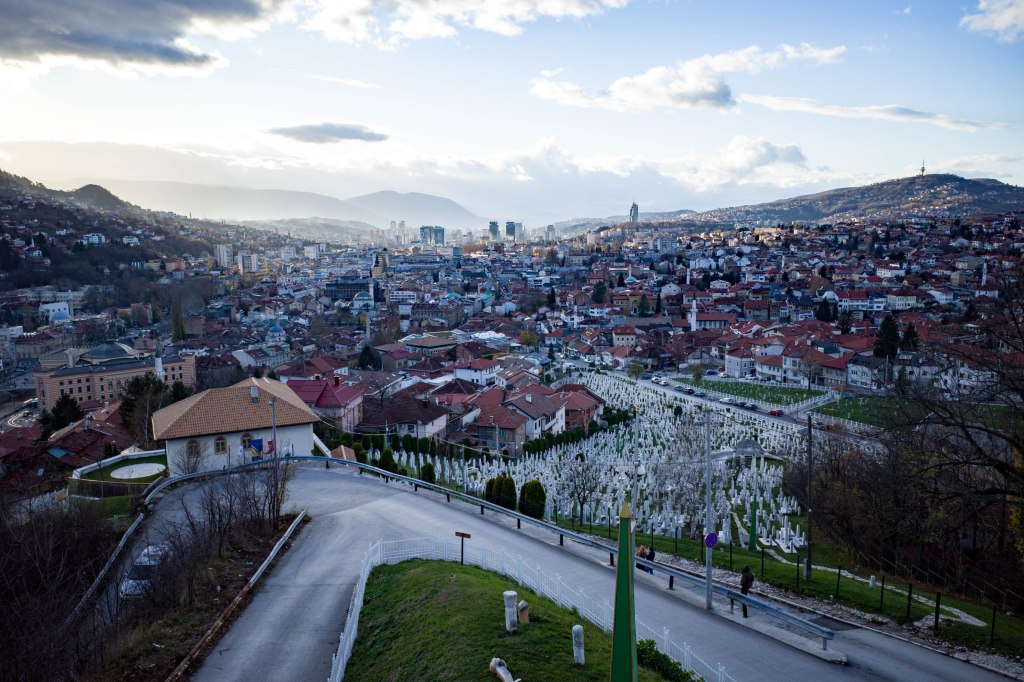
In Sarajevo there is a distinct line where East meets West. On one side is the Ottoman market district, dating back 500 years to the founding of the city, full of domed roofs, mosques, and narrow streets. On the other is the Austro-Hungarian area, only 100-150 years old. Here buildings have ornate sculpted facades and would not look out of place in Austria, or Hungary for that matter. This is just in the old town. There are also drab concrete apartment blocks that, like many buildings in the city, are pocked with shrapnel damage from the siege. I also saw some skyscrapers for the first time in awhile.
Suffice to say, this is an interesting city with a turbulent history. An important Ottoman trading city for centuries, then the site of the spark that ignited The First World War when Archduke Franz Ferdinand was assassinated near the beautiful Latin Bridge. In 1988 Sarajevo hosted the Winter Olympics and only 8 years later the longest siege in modern history occurred here.
The Bosnian war and the Siege of Sarajevo occupied most of my interest while I was in the city. It’s hard not to think about it when you’re here, there are reminders of it everywhere. The aforementioned shrapnel scars are still visible on buildings throughout the city, they simply can’t afford to repair every building. Then there are the Sarajevo Roses. If you look down while you walk you will notice these splashes of red on many streets. The red is resin that has been poured into the scars of mortar shells which caused fatalities during the siege. There are hundreds in the city.
The Museum of Crimes Against Humanity and Genocide gives an uncompromising look at the horrors of the Bosnian War and the Siege of Sarajevo. Since these events happened only 25 years ago, there is plenty of video footage and photography documenting the war. This made for the most difficult museum experience I’ve had yet. The atrocities were not just words or numbers, they are there for you to see. I’m not going to tell you about them. If you were alive in the 90s you likely already have some idea. What stuck out to me however was how resilient the people of Sarajevo were. They were living in horrible, traumatizing conditions for almost four years, but life went on. Children attended school, people went to work. People went to the theatre. There was a film festival, beauty pageants, and fashion shows. The people of Sarajevo kept going, and survived for almost four years a siege that was meant to break them completely and utterly. It’s quite inspiring.
I’m sorry if this post has been a bit dark and depressing. Sometimes that’s how life is. Be glad that you grew up safe and sound and that you are only reading about these things. And if you have lived through some tragedy, even if it’s ‘minor’, I salute your strength and bravery.
Okay, enough of this. What happened to sarcastic, ironic, irreverent Dylan? I’ll leave you with this. The Bosnian war was conflicts between three ethnic groups: Bosniaks, Serbs, and Croats. They all speak the same language, are all Slavic peoples, all lived together in Yugoslavia. What is the difference between these peoples? What determines their ethnicity?
It’s religion.
 And whither then?