I’m super happy to be in Bulgaria. It’s such a nice change from everywhere else I’ve been for the last two months. I’ve enjoyed every country so far, but the differences between countries has been subtle. If I were to go straight from Estonia to Romania I would of course notice big differences, but since I’ve made my way south more slowly, each country has been only a slight change from the one before it. This makes Bulgaria refreshing, as for the first time I feel that I’m somewhere different from where I’ve been before.
I guess it feels like I’m finally in the south of Europe. The weather’s been warm since I got to Poland, but it’s even warmer here. The landscape is starting to feel Mediterranean, the architecture as well. It’s nice.
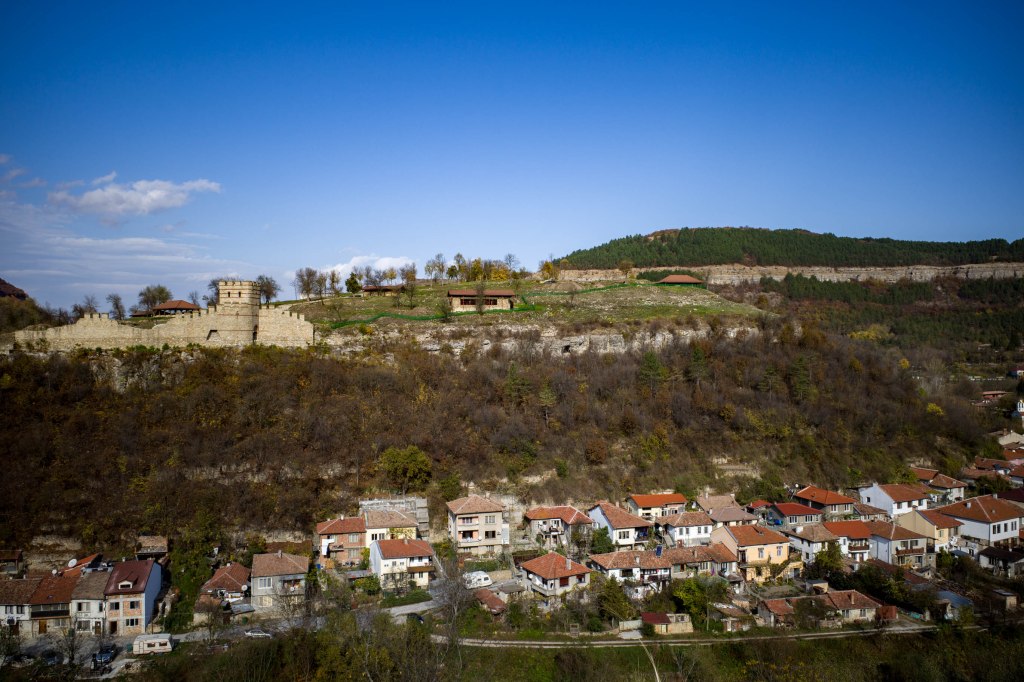
Admittedly I am in a beautiful old town in Bulgaria. I’ve yet to visit a big city, so opinions may evolve. I had to change buses in the city of Ruse right after crossing the border from Romania, and it was an uninspiring place. A couple of hours later, however, I was in Veliko Tarnovo, gazing up at the massive ruins of the Tsarevets Fortress, illuminated with the warm light of spotlights.
Veliko Tarnovo was the capital of Bulgaria during the middle ages, and it has a suitably large fortress to go with the title. Even in ruins Tsarevets is an imposing sight, covering a hilltop near the old town, with a causeway leading up to it. It’s a beautiful sight. The church in the very centre of Tsarevets has been well preserved and has very unique, modern murals inside.
I spent most of a day here just sitting in the sun reading. I’ve been travelling all this time, but now I feel like I’m on vacation.
I don’t really know what else to say. It’s lovely here, but words are failing me at the moment.
Today marks 2 months, or 60 days of travel. Time hast flew-eth.
Hello from Bucharest! or is it Budapest… Where am I? Oh well, the journey is more important than the destination they say, and my journey here was quite interesting, although the destination, Bucharest, is rather nice as well.
A bus from Chisinau takes 7-8 hours, the train takes 13. I took the train. It is also more expensive than the bus, but I was travelling first class. That’s correct, I booked a ticket for a first class berth on the overnight train from Chisinau to Bucharest, it was only $7 more than second class anyhow. Luckily I had read up on the journey beforehand, or I may have been somewhat shocked with what I discovered. The train has been described as a rolling Soviet museum, it appears relatively unchanged since the 50s or 60s. First class is not comfort class, but it was an experience. My cabin had two seats/beds. Nobody joined me on the journey. The train was a quarter full at most. The conductor is a gruff Moldovan man who speaks Russian.
Why does the train take so much longer than the bus? Well partly it’s because the train is very slow. Mostly it’s because they have to lift the train up. Train tracks in the former Soviet Union are a different size than those in the rest of Europe. This means that at the border with Romania they have to lift each carriage individually and change its wheels to fit the tracks. This, along with the border crossing, took about two hours, starting at about 7pm. If you take the train in the opposite direction you get woken up by immigration and customs at 3am.
The Moldovan customs officer poked through my bag and checked every possible storage spot in the cabin. Her Romanian counterpart said hi, asked if I had cigarettes or alcohol, and wished me a good journey. A middle aged Moldovan lady came by to ask if I was feeling well. I was.
While all this was going on the carriages were jacked up, and the new wheels installed. I watched the process happening to another carriage out of my window. I didn’t even feel when my own carriage was lifted or lowered. The experience was not all it was chalked up to be.
After that it was smooth sailing all the way to Bucharest. And when I say ‘smooth’ I mean ‘not smooth’. The train bumped along all through the night, and while my little bed was comfy enough, I’ve had better sleeps. That morning at 6am there was a knock on my door letting me know we were about to arrive, and just like that I was in Bucharest.
Many of the old buildings here were destroyed by Nicolae Ceaușescu, the Communist leader of Romania from ’65 to ’89, to make way for his massive building projects. One man saved over twenty buildings and churches by lifting them, installing train tracks underneath, and rolling them out of the way. This includes one apartment building which he moved with the residents still inside. There are still some nice buildings, especially ones from the turn of the century when French style was all the rage. The biggest attraction here is the biggest, literally.
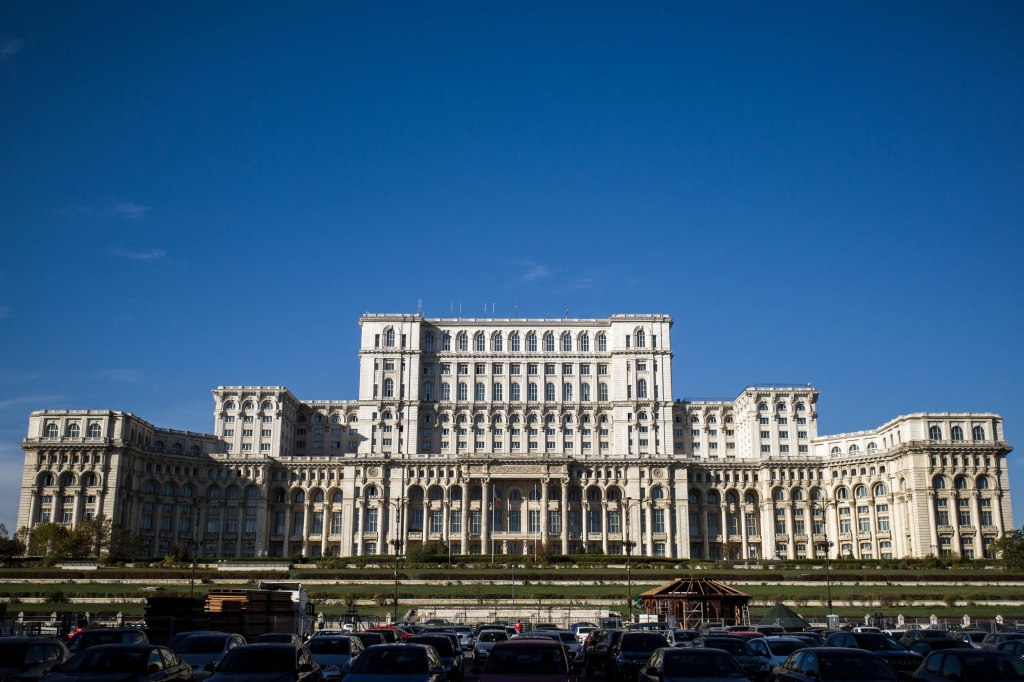
The Palace of the Parliament is the second largest administrative building in the world, after The Pentagon. It is also the heaviest building in the world, on account of all the marble, and carpets, and 16m high velvet curtains. Construction was started in 1983. Many of the best architects from Romania and worldwide submitted designs. Ceaușescu chose the design of a 27 year old straight out of school because hers was the largest, no other considerations. It was meant to take two years. When communism fell and Ceaușescu was executed in 1989 it was not complete. Since they had all the building materials ready to go they continued the project, finishing in 1996. There are over one thousand rooms inside. It currently houses the Romanian parliament, many government offices, a contemporary art museum, some restaurants, and other things. Less than 400 of the rooms are in use. You can rent them for conferences and other events.
As stupid as the building is, almost all of the building materials came from Romania, which is nice. There is marble everywhere, and expensive wood. The hundreds of chandeliers are made of crystal. If they turned on all the lights at once it would cause a power outage in Bucharest. The carpets are so large that they were made in pieces and stitched together once they were inside. I took a tour. We walked two kilometres (not in a straight line), and up 300 stairs, and saw only 5% of the building. I still struggle to grasp just how large it is. It is as big under the ground as above it, with a nuclear bunker at the bottom.
Ceaușescu wanted a massive balcony on the front so that he could give speeches to massive crowds of people. He died before the balcony was completed. The first person to speak from the balcony was Michael Jackson. He said, “It’s really good to be here in Budapest“. Many other international musicians have made this mistake. The second time Iron Maiden played Bucharest the road from the airport was lined with billboards saying, “You are in Bucharest, not Budapest”. Some tourists book a ticket to the wrong city. I was here on purpose.
I also visited Ceaușescu’s house. This was his private residence for him, his wife, and his three children. It was not as large as I expected, but I think that if I had not just been in the massive Palace of the Parliament I would have been more impressed. It was a pretty darn nice house.
I saw some other things in Bucharest, but these stood out.
I’m walking down the street in an unrecognized country in Eastern Europe. It is night time.
Eight hours earlier I was boarding a minibus in Chisinau, capital of Moldova. Minibuses, or marshrutkas as they are called in Russian, are a very common form of transport in this area of the world. It’s like a large van, seating about 15-20 passengers. My minibus goes to Tiraspol, capital of the unrecognized republic of Transnistria (Pridnestrovie in Russian).
Moldova was a part of the Soviet Union. With the collapse of the USSR, the Moldovans, who are primarily of a similar ethnicity and culture to Romania, began to set up their own country. In the east of Moldova, across the Dniester river, the ethnically Russian population were not happy about this, so they formed their own country, Transnistria.
A short war later and they were still part of Moldova. Since then they have operated as their own independent country. Although Moldova considers Transnistria to be part of itself, they have essentially let the state be. Transnistria has its own government, currency, and even passports (although most citizens have Moldovan or Russian citizenship as well). No countries recognize Transnistria. Three other unrecognized countries recognize Transnistria. Abkhazia, South Ossetia, and Artsakh. Despite its status, and unlike other unrecognized countries, Transnistria has been conflict free for years, making it an ideal destination to travel if you want to get off the map a bit.
As I waited for my minibus to leave the station, who should arrive but two other travellers who were at the same hostel as me in Chișinău, and would be staying at the same hostel in Tiraspol. Hearing us speaking English, a lady on the bus strikes up a conversation. Her English is excellent. She works in Chișinău and is returning home to Tiraspol for the weekend.
The bus sets out. I’ve mentioned already that the roads in Moldova are bumpy. Most of the journey is on a two-lane road. Traffic generally drives half in the lane and half in the shoulder, allowing cars to pass down the centre line regardless of oncoming traffic. Some of the journey is on a three-lane road where the centre lane is seemingly reserved for passing in both directions. It’s exhilarating.
We arrive at the border. Most of the passengers on the bus must be Transnistrian because they don’t have to do anything. Us foreigners get off the bus and head into the tiny immigration office. Our new Transnistrian friend comes along and speaks to the officer in Russian for us. There are no problems. It would have been fine without her help, but a few years ago we likely would have had to navigate bribes and poor communication. They don’t stamp your passport here. Instead, you get a slip of paper with your details to keep with you until you leave. We have arrived in Transnistria.
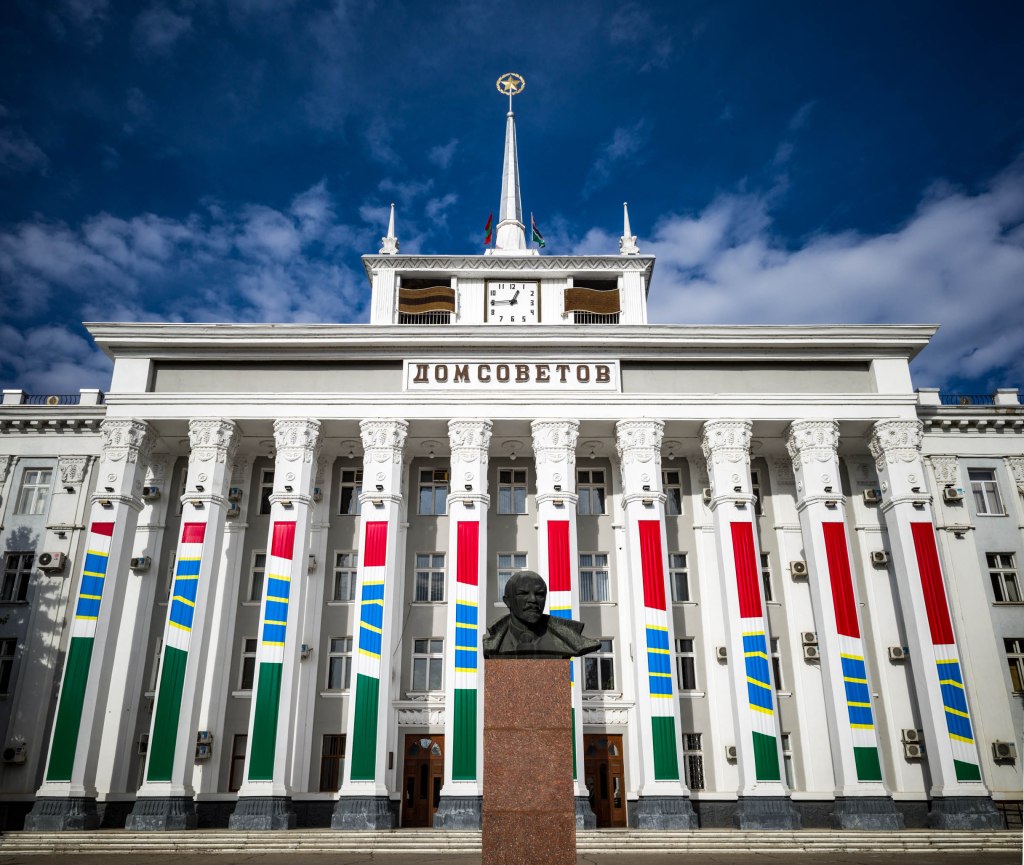
Immediately after crossing the border the roads improved. I guess Transnistria is putting the money they receive from Russia to good use, while in Moldova who knows where the tax dollars go. That being said, the capital Tiraspol is fairly similar to Chișinău. Slightly better sidewalks, and more statues of Lenin being the main differences. Oh, and it’s very quiet. There isn’t much to do here.
Upon arrival, we exchange our Moldovan Lei for Transnistrian Rubles. The currencies have very similar values, but the Ruble is worthless outside of Transnistria. You can only exchange it back to real money while in Transnistria. You can’t pay by card anywhere in the country.
Our hostel in Tiraspol, one of three available, is fantastic. There are three other travellers already there, and when we arrive the owner has just finished making borscht. Maybe it was special for Saturday night, free breakfast is also included.
Oh yeah! The cliff-hanger from the beginning of my story…
Bang! Bang! Bang!
We’re walking along the main street that night when we hear these sounds from the building next to us. We look over to see fireworks exploding above the roof of the building. Maybe November 2nd is a special day? I think someone was just setting them off for fun.
We’re heading to a pub, we think. There aren’t many options here. It’s called Bro Beer Burger. It’s pretty upbeat. There are many young people here. One group of young men (I later learned they were 16-year-olds), realize we are foreigners and immediately welcome us. They’re excited and amazed that anyone is visiting their country. A beer is $1. A boy who looks younger than 16 buys us shots of vodka.
I had a decent conversation with one of the guys who spoke fairly good English. He’s not so happy with the country since there’s little to do and few opportunities. His family wants to move to America. The others don’t know much English, but at every opportunity they say “thank you for coming here”, and “we love you”. We end up at a club. It was a half-decent club I think… I really wouldn’t know. I’m uncomfortable enough at a club in Canada, so a club in Transnistria was really not my scene. I left before the others.
The next day I walked around the city. There’s an old amusement park. It’s still operating. Looks like a good way to injure yourself. There are some old Soviet buildings. Two statues of Lenin. A couple other sights. Not too much. A meal with a glass of Transnistrian wine is $5. Tiraspol has the Kvint factory. They make what is supposedly the best brandy in Eastern Europe, as well as wine and vodka. A bottle of vodka is as little as $1. The tourist information centre, which doubles as the country’s only souvenir shop is closed while moving locations, so my only souvenirs from the country that doesn’t exist are some worthless money and my immigration paper, which is printed on receipt paper.
I have been to many places, and have many more to see, but Transnistria will always be one of the most unique.
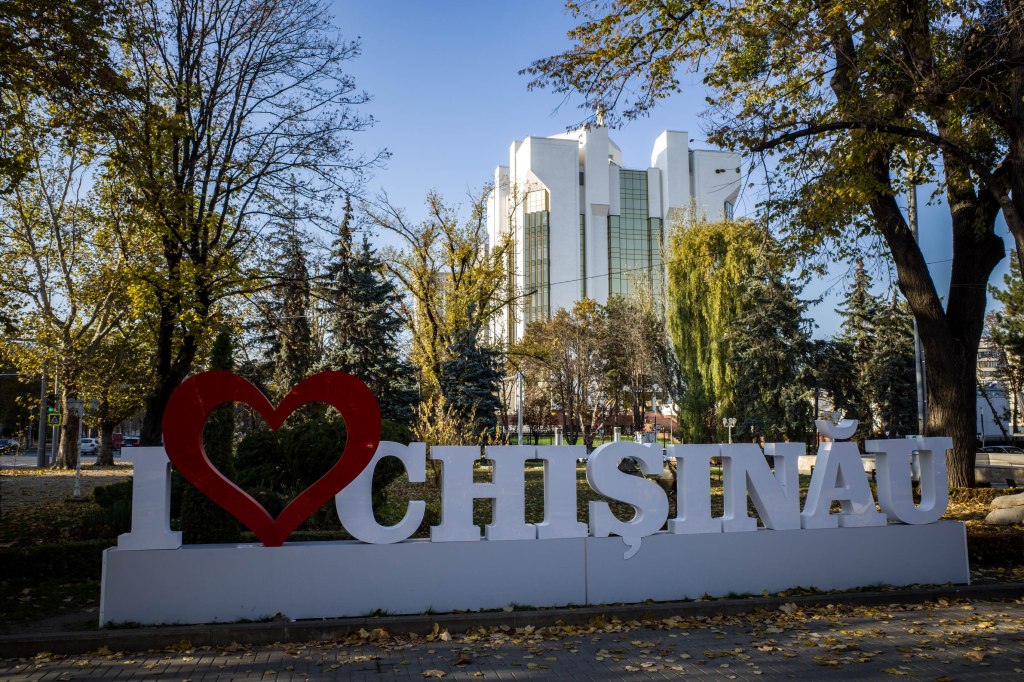
Chisinau could use some sprucing up. In fact, when my bus crossed the border from Romania into Moldova the roads instantly became bumpier. As we bumped along the road to Chisinau we passed other road users such as cars, and trucks, and horse carts. Dilapidated could be one word to describe the city. The sidewalks are cracked, uneven, decaying, you always need to watch your step.
And yet it’s quite nice here. People are friendly, there’s some things to see, some lovely parks. I wandered the city, taking in the atmosphere that is very pleasant despite the disrepair of the streets. And of course the interior of shops and restaurants is modern and clean and nothing like the exterior. In the centre there is a massive indoor and outdoor market, where you can buy everything from cheese and fish to clothes to bed sheets, and the amount of produce for sale was a breath of fresh air after the sad selections in many grocery stores I’ve been in recently.
I visited the National Museum of Ethnography and Natural History, a ticket for which costs less than one dollar. I think it would have been a top notch museum maybe 30 years ago, and it’s still quite good, but not very modern. They have a huge collection of taxidermised animals, and fossils, and info about the geography of Moldova, as well as the history of people in the area from the stone age till the present day. I probably would have learned a lot if there had been any info in English. It didn’t help that since I arrived with only 45 minutes till closing there was a strange old man shooing all the visitors to follow the same route and hurry up so that he could turn off the lights in each section after us. But as I said earlier, $1.
I was very happy to find a bar serving Moldovan craft beer. It was surprising to find, and even more surprising that there was quite a good selection of quality beers. Moldova is known for their wine, so I certainly didn’t expect a menu of 20 different beers from 4 local breweries.
A highlight of my time in Chisinau was exploring an abandoned observatory. Right next to the main road and the University of Medicine is a building with all its exterior walls removed. Upon climbing to the top floor there is a tower leading into the dome of an old observatory. The building is covered in graffiti and piled full of trash, and it made for a fun bit of exploration.
Well, that’s about all I have to say about the least visited country in Europe. Join me next time for an even less visited country in Europe.
It was an eight hour bus ride from Budapest to Cluj, half of it in the dark. I saw very little of the Romanian countryside on account of this, which is a shame. I was especially sad for the darkness because the roads we drove once in Romania felt quite exciting. We drove downhill for quite some time on a narrow, winding road full of switchbacks and tight corners. I suppose the darkness added to the excitement of the drive, as all I could really see were the headlights of oncoming traffic.
And then I arrived in Cluj-Napoca, Cluj for short, largest city in a certain region of Romania you may have heard of before, Transylvania… Ever since arriving I must admit I find myself less sanguine than usual. I feel somewhat drained. I awaken in the morning feeling weak and somewhat faint. I shy away from the sun…
I only kid. I feel just fine and there are absolutely no vampires here. I cannot stress enough the fact that everything is normal.
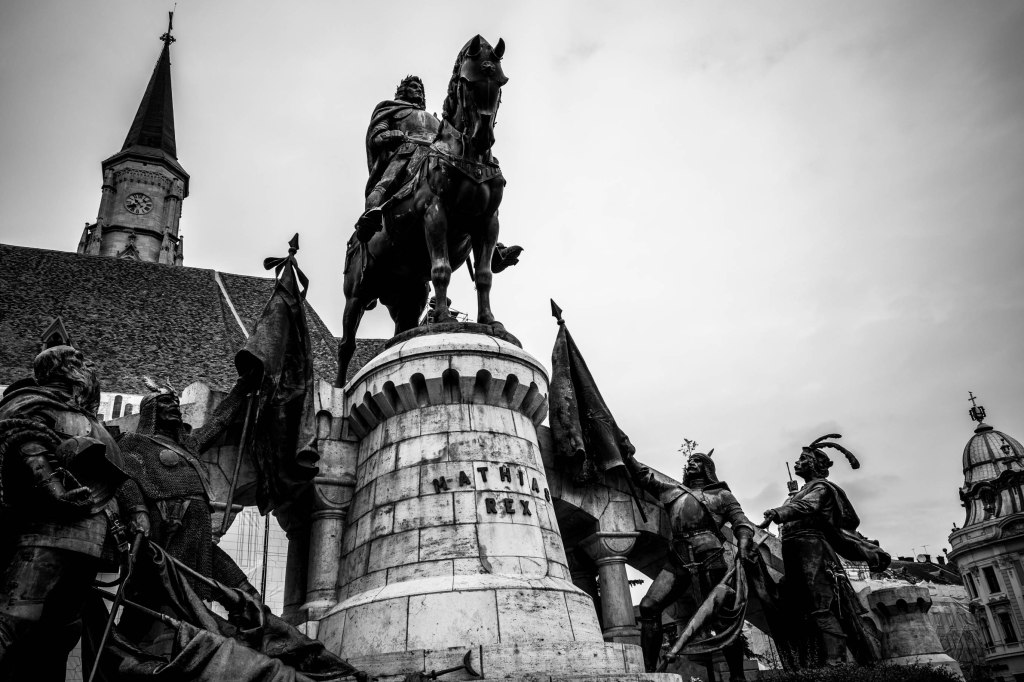
Cluj was under construction, or renovation I suppose. The cathedral was shrouded in cloth, another large church was infested with scaffolding, and the purportedly stunning ‘mirror street’ in which both sides of a street are identical, is somewhat lopsided with one half being refurbished. It was an interesting city to spend some time in nonetheless. Fairly quiet, good coffee, small streets and wide avenues. I spent an afternoon walking in a park on a hill, trying not to trip on the decaying concrete paths and steps. There were a couple dozen strange concrete cylinders jutting out of the ground on a hillside. They extended about half a meter above the ground, and since many were missing their tops, I could see that metal rungs set in to the walls allowed you to climb several meters beneath the surface, not that you’d want to with all the empty bottles people have thrown in them. Perhaps the cylinders were once sarcophagi for the vampires which used to roam this land. I do not know the answers.
I ate a rather interesting food here, from an etymological point of view. Plăcintă is a disk of dough filled with cheese, potato, or cottage cheese. They were available from the windows of little shops for about one dollar and were rather tasty. The name plăcintă comes from the Latin placenta, meaning cake. You may also associate placenta with something else that is not a cake. However, it would seem that the term placenta in English got its meaning because it resembles, in shape if not in colour, a flat, disk-like cake such as a plăcintă. There’s your fun fact for the day, now go away.
 And whither then?