Image

Shkodër, Albania

The drive into Albania was beautiful, until it wasn’t. For the first couple hours the road wound through breathtaking mountains with picturesque villages in the distance. Then we got to the lowlands and it was impossible to tell where one town ended and the next began. For over an hour we drove through outskirts. Crappy looking roadside hotels and building supply stores. Then the bus dropped me off on the outskirts of Shkodër, this bus just skipped by the city without going to the center. So I walked for almost an hour down the main road to the center of town. It was not an inspiring start.

Actually, it was quite interesting. But I was tired and had not been expecting such a walk. Also it was chaotic and kinda dirty. The road was two lanes in each direction plus curb parking, but people stop their cars in the lane next to the parking lane. There are as many bicycles as cars and it’s a bit of a free for all. People sit on the sidewalk with little displays of goods for sale. Fruits and vegetables, shoes, odds and ends. Chickens are tied by their legs to the handlebars of some bikes. Live chickens.

And then I made it to the center of town, and just one street over from the craziness is a whole other world. An elegant pedestrian street. Peaceful narrow lanes. My hostel.

Shkodër features two of the best museums I’ve seen in a while. The Museum of Memory was yet another museum dedicated to the atrocities of the communist regimes, set in yet another old prison. This one was distinguished by having an exhibit chronicling every single totalitarian regime in Europe – Nazis, fascists, communists, on a country by country basis. This was interesting, but soon became overwhelming, and the numbers blended together and became unreal. Simple statistics are not a good way to communicate the numbers of people murdered and deported. The other museum was much happier. It was an exhibition of photos taken by a family of influential Albanian photographers from the beginning of photography up to the 1970s. The photographs were excellent and portrayed both the history of Albania and of photography.

A big draw of Shkodër, other than hiking the nearby mountains, is Lake Shkodër. So I just had to get out of town and enjoy the lovely lakeshore. Luckily, my hostel had bikes to rent. That’s how I found myself biking out of town, on the road I had all too recently considered chaotic. Now I was part of the chaos. Cycling alongside and inside of traffic. Dodging Albanian drivers like the best of them. Actually, once you’re out there, it’s not as wild as it appears. People drive very slowly in town, and they’re used to cyclists. An employee at my hostel figures that Shkodër has the 7th most bikes in Europe per capita, which makes sense. It’s flat and perfect for biking.

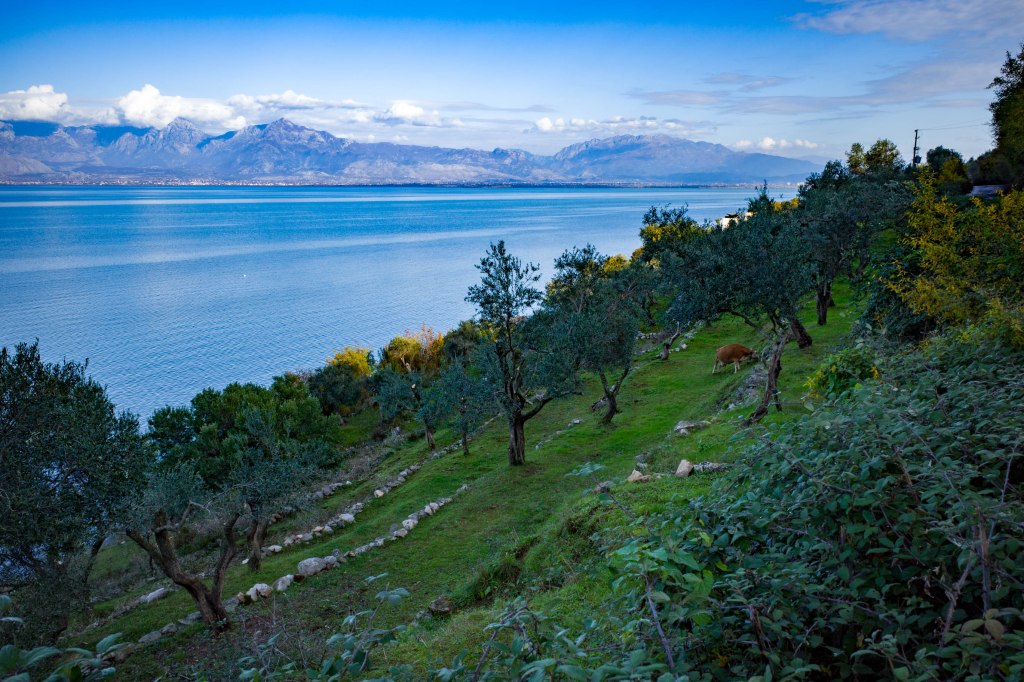
Then I was out of town and biking along the shore of Lake Shkodër. On my left, mountains. On my right, lake, and then mountains. In front of me, a narrow winding road.

After a leisurely hour and a half of biking the road runs out. Not much further and you’d cross the border into Montenegro.

Like any city worth its salt, Shkodër has a fortress. Situated on a hill just outside of town, it offers an excellent view of the city and surrounding countryside.

Albania is the least familiar place in Europe. It’s the furthest from Canada or the rest of Europe that you can get. Spending longer here and seeing more of the country would be quite an interesting experience. But my time in Europe is running out, and I want to hit a few more countries before I have to call it quits. So it’s so long to Albania and zdravo to Montenegro!
Enjoy some photos!

Image

Prizren, Kosovo

The central square of Prizren is surrounded by cafes and restaurants, their patios full of locals drinking tea or coffee and chatting away. I took their example and spent a good deal of time sipping tea at a lovely cafe in the garden behind the Sinan Pasha Mosque.

Minarets dot the horizon. Throughout the day the call to prayer sounds out. There are always several mosques within earshot and they never quite seem to be in sync, so a multitude of voices create a beautiful cacophony.

The narrow streets barely have sidewalks, so one must keep their wits about them and always be prepared to step out of the way of a car. Kosovans have been very friendly and helpful, but once they are behind the wheel of a car it feels as if they will run you down with barely a second thought. Welcome to the Balkans.

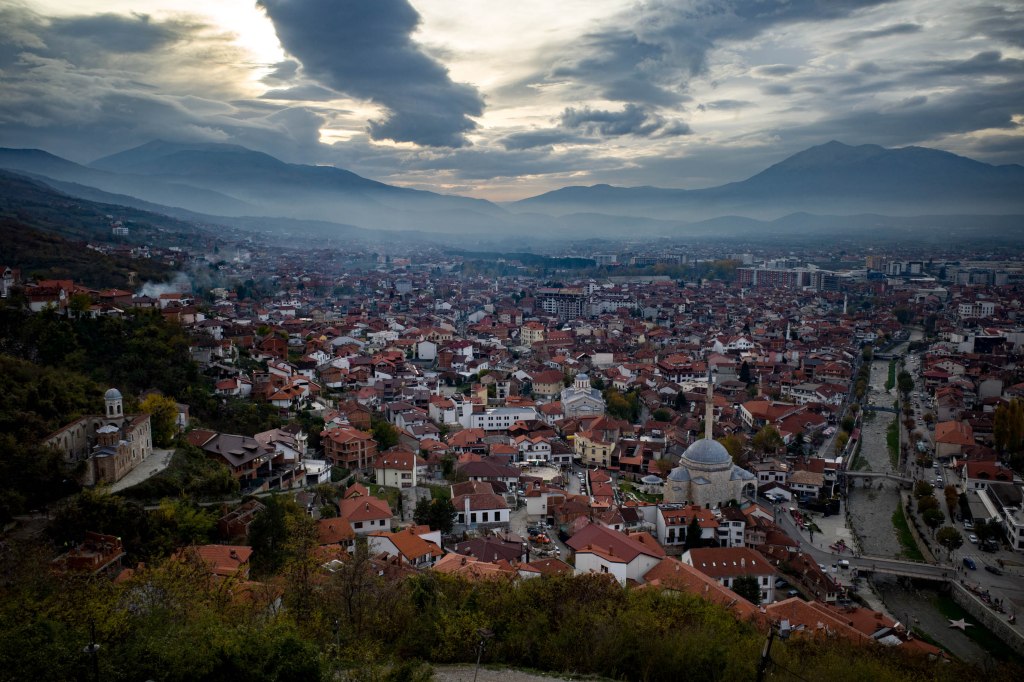
Yet another fortress sits above the city. It’s accessible via the steep, winding streets, or you can walk out of town along the river, and through the forest to approach the castle from the back. From above Prizren is a sea of red tile rooftops, pierced by the aforementioned minarets, flowing up to the mountains in the distance.

Photos.

Image

Skopje, (North) Macedonia

North Macedonia, the Republic formerly known as The Former Yugoslav Republic of Macedonia.

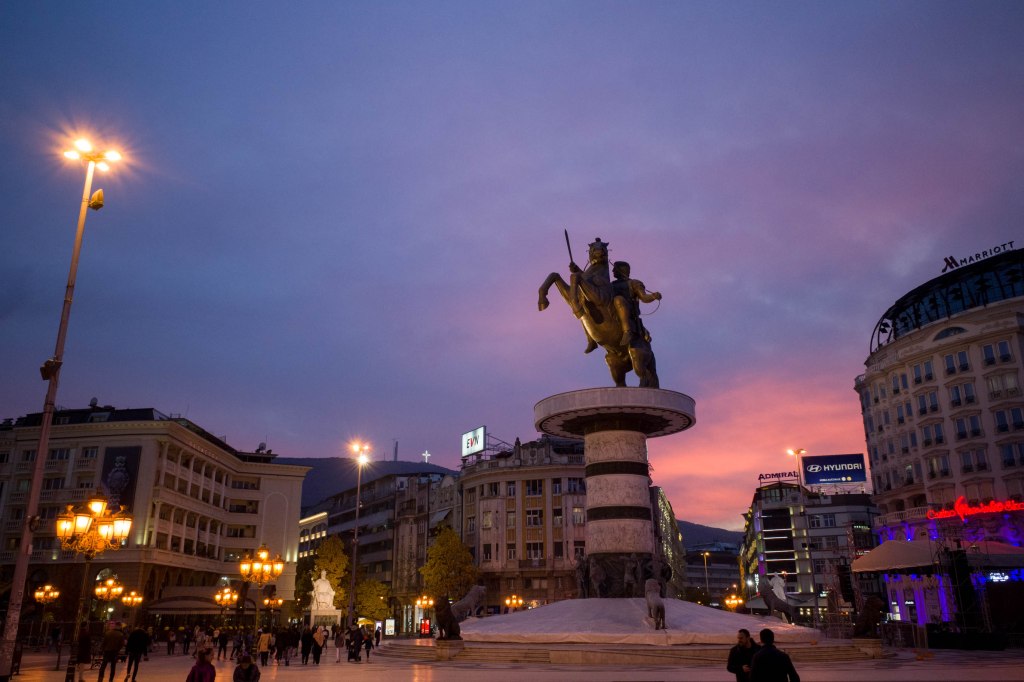
Skopje is the weirdest city I’ve ever visited. It may be the city with the most statues, it certainly feels like it. Highest density of statues at the very least.

When I arrived at night by bus I was greeted by a vision of a neon cross hovering high above the city.

“Is this it?”, I thought, “Is God finally revealing itself to me, proving my atheism to be a foolish mistake?”

In a word, no. The neon cross was a very man made item. It was the Millennium Cross, built to celebrate two millennia of Christianity, seated atop a mountain overlooking Skopje. It is the second largest cross in the world, the largest metal one.

As you walk along the river towards the centre of the city you will see many beautiful Baroque and classical style buildings. You will see uncountable statues of important Macedonians. You will see at least twice as many bridges as necessary.

Don’t be fooled. These beautiful old buildings and statues were mostly built between 2010 and 2014. They are built in styles that never existed in this area historically. When buildings like these were being built in other parts of Europe, Macedonia was part of the Ottoman Empire.

Skopje has been nearly completely destroyed three times by earthquakes in the last 1500 years, most recently in 1963. This is why there are very few real historical buildings in the city. The country and the city have also been very corrupt, which is why unthinkable amounts of money has been spent on statues and pretty buildings.

How does Dylan know all this? you wonder. Well, let me tell you. I’ve often been going on free walking tours of cities. It’s a good way to learn about the city, and figure out what you want to look more closely at during the rest of your time. These tours are generally pretty good. The one in Skopje is the best yet.

It didn’t hurt that only three of us turned up for the tour. This made for a more intimate, personal tour than you usually get. We were outnumbered by the stray dogs that followed us along our way. They had tags indicating that they had received shots and been fixed, so they were very friendly and not aggressive. Unless you’re on a bicycle, that is. As we walked the streets of Skopje our posse of dogs kept us very safe from cyclists, barking and biting at ankles, as well as chasing any car that dared to drive by.

So we had pets and protection, good start. We also had an excellent tour guide. Mihal was the friendliest, most welcoming guide one could hope for. Our tour went much longer than usual because we were talking for so long. Mihal brought us to a restaurant and treated us to rakia, Balkan alcohol made from plums, grapes, or other fruit. He said we’d take a 20 minute break there. We ended up staying for an hour and twenty minutes. Of course stopping there is just part of his standard tour, but getting an in-depth, fairly unbiased, explanation of the issues around the name Macedonia, was a bonus.

Also as part of the tour we got a coupon for free rakia, and one for free beer. Although the value of such things was $3 max. But I drank well that day.

Anyhow, back to the statues. There’s a massive equestrian statue of Alexander the Great, but it’s officially called “Man on Horse” or something, so as not to bother the Greeks who think they own Alexander and the name Macedonia. There is a fountain with four statues of Alexander’s mother in it. There is a statue of his father. There are two bridges with about 30 statues on each of them. There are countless other statues. There is a triumphal arch, even though Macedonia has had no military triumphs in the last 2000 years.

Even knowing none of the story behind how silly all these things are, it still feels pretty absurd. When I first walked into the centre I was thinking “what the heck”, at every turn.

There are a handful of actual historical buildings still remaining in the city. One famous bridge, the large fortress, and many buildings and streets in the Old Bazaar area.

The Old Bazaar is windy cobblestone streets with shops and restaurants crammed into every available space. Apparently restaurants don’t have to pay taxes in the bazaar if they keep their building in its original condition, so prices are very cheap. It’s the perfect place to sit outside sipping a glass of Turkish tea or rakia, as the mood takes you, and watching the bustle of people.

Some fun facts about Skopje. Mother Teresa was born here. After the 1963 earthquake, because Yugoslavia had relations with both the USSR and America, relief was sent from both countries to Skopje. As a result, American and Soviet soldiers shook hands for the first time since the Cold War began.

All of the city’s buses were destroyed when their garage collapsed in the earthquake. So London sent some of its double-decker buses to help out until Skopje replaced their fleet. Now, in the last few years, Skopje’s newest buses are double-decker and built in a retro style to look somewhat like London’s buses of the 60s.

I highly recommend Skopje. You’ll never see another city like it.

Photos. Barely capturing the oddness.

Image

Sofia, Bulgaria

Sofia doesn’t make the best first impression. It’s a big, dirty city, and after the other beautiful places I’ve seen in Bulgaria it looked pretty grim in comparison. At first.

Just like Plovdiv, Sofia has a long history. You’ll find Roman ruins, medieval churches, and Communist apartment blocks all jostling for room here. The apartment blocks win.

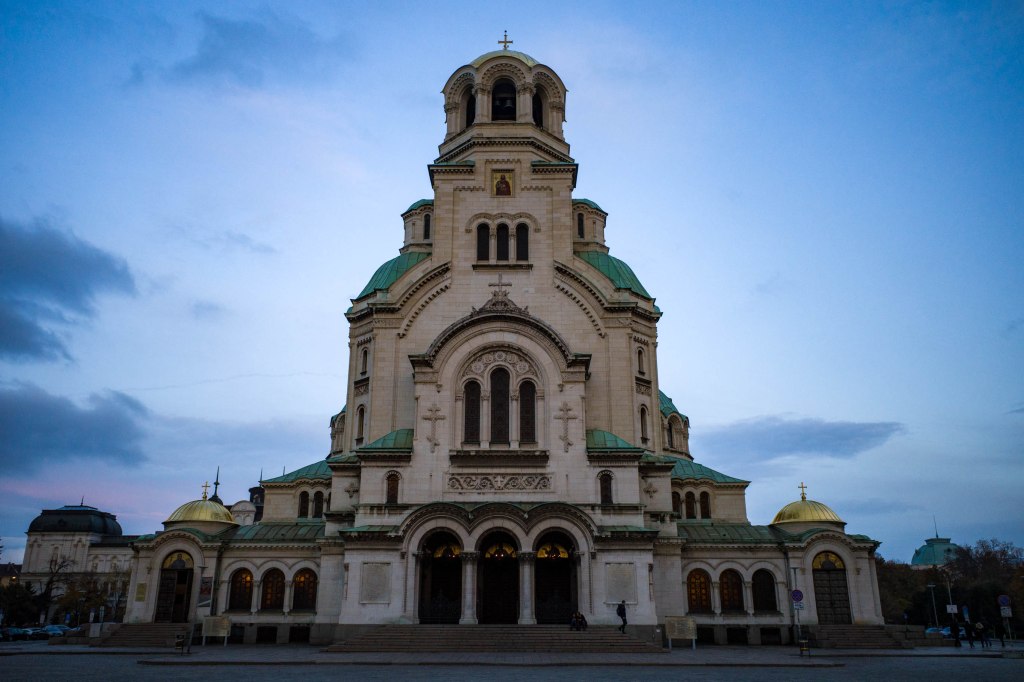
Nonetheless there are some very beautiful parts to the city. The Orthodox churches are beautiful, and in the centre there is an Orthodox church, a Catholic church, a mosque, and a synagogue all within sight of each other.

Speaking of the synagogue, which has a beautiful interior, all of Bulgaria’s Jews survived the Holocaust. Although Bulgaria allied itself with the Axis, when Hitler asked in secret that they deport the Jews, it didn’t remain a secret. People took to the streets in protest, with Christians wearing Star of David armbands in solidarity. The government couldn’t really stand up to Nazi Germany’s power, so instead they delayed and deflected. They said that the Jews were busy doing labour and they would be sent once they were done. Eventually they delayed long enough and the war ended.

I visited a very interesting museum called ‘The Red Flat’. Museum doesn’t really describe what it is, which is a fully preserved communist era apartment. You enter with an audio guide and can walk around or relax while you hear stories about everyday life and the people who owned the apartment during communist times. You’re free to touch everything in the apartment, so you can flip through books, put on records, and fiddle with various vintage varietals. It was a pretty cool experience.

Sofia was a perfectly lovely city in the end, and it speaks to the quality of Bulgaria that it is my least favourite place in the country.

Bulgaria has really been my favourite country so far, and I’m sad to leave. But I’ve been here longer than any other country so far, and any of the upcoming countries could overtake the top spot, so I will continue on.

Enjoy a few photos.

Image

Plovdiv, Bulgaria

I am loving Bulgaria. I think I already mentioned that. Even though I encountered my first (minor) setback of my trip so far.

My trip has been going super smoothly, everything working as planned, always getting where I want to go. So it was about time something went wrong. It was really such a small problem that it hardly bears mentioning.

There I was in Veliko Tarnovo, all ready to catch a bus to my next destination of Plovdiv. I arrived 45 minutes early to the bus station (the bus stations in Bulgaria are in annoyingly non-central locations), and went to buy my ticket.

“It’s finished”, the ticket salesman tells me. For some reason ‘finished’ seems to be the English word used throughout Eastern Europe for ‘sold out’, or ‘closed’. So all the tickets to Plovdiv were sold out for the day. I guess Veliko was a popular weekend getaway for Bulgarians and they were all heading back home.

After sitting dejectedly for a few minutes, I booked a ticket for the next morning, and headed back to the hostel for another night. If I could have been stuck anywhere for an extra little while, beautiful Veliko Tarnovo was a good option.

The bus to Plovdiv takes four and a half hours. One full hour of that time is the bus sitting around at a rest stop in the mountains and a bus station in another city. It was also the first bus driver I’ve encountered who seems to follow the speed limit. Bus drivers throughout my trip so far have been all about efficiency, speeding down the road, passing at every opportunity. This bus driver was positively slow. We were on some winding mountain roads, to be fair, but even so I expected a bit more verve from the driver. The drive was beautiful at least.

One unnecessarily slow bus ride out of the way and I was in Plovdiv, the European Capital of Culture this year. It’s also the oldest city in Europe, so they’ve had plenty of time to perfect their culture.

Plovdiv feels like a city of culture, and like an old city. In the old town every one of the beautiful houses contains a museum or gallery. The upper levels of the buildings jut out over the street, a tricky construction technique to get more floor space without paying for a larger plot of land. The cobblestone streets in this area are the most rugged I’ve seen yet. But the old town is hardly the oldest thing in town.

Plovdiv has been a city occupied by many cultures over the years. Thracians, Macedonians, Romans, Bulgars, and the Ottomans all put their stamp on Plovdiv before the modern Bulgarian state was formed one hundred years ago. There is a gate in the city wall that may date to the Macedonians. There are also some excellent Roman ruins here. I love medieval stuff and Communist stuff, but my journey has been lacking Roman stuff up to this point.

Plovdiv has an amphitheatre that still hosts concerts (sadly none while I was there), and seated six thousand back in it’s prime, a stadium which seated thirty thousand but is mostly buried today, and other Roman ruins. Apparently, being named Capital of Culture gave the city more incentive to excavate and display some of these ruins, with some being made open to the public only months ago.

Seeking to become the Capital of Culture also caused the city to clean up an area in the city centre that was basically streets full of parked cars seven years ago. Today the area is full of cool cafes, restaurants, and bars, as well as beautiful street art.

There is also one of the longest pedestrian streets in the world, and it wouldn’t feel out of place in Western Europe.

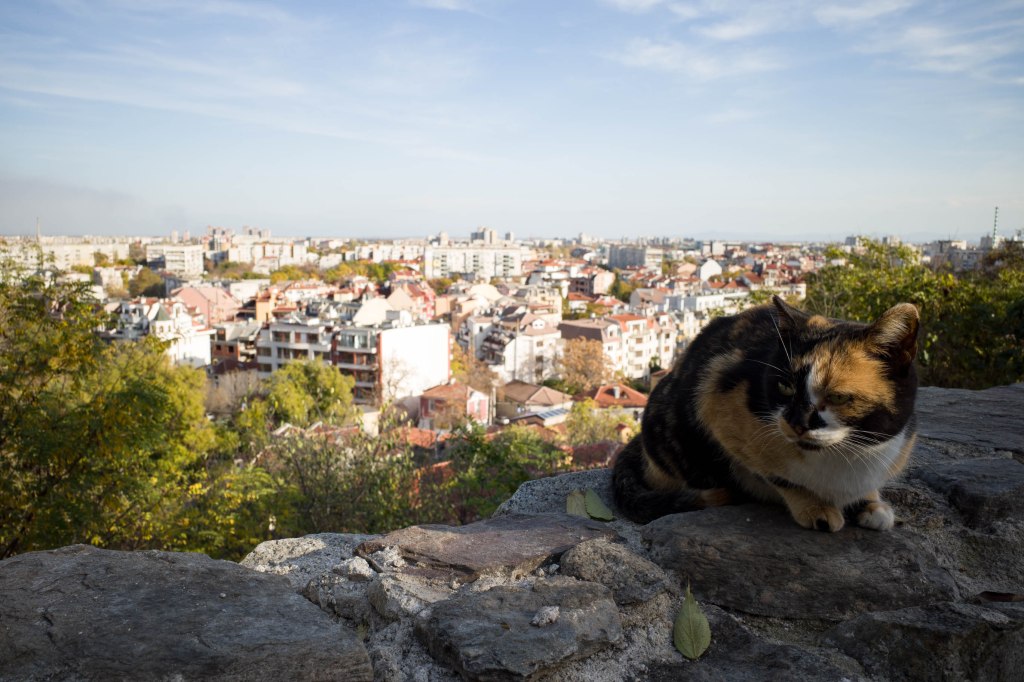
Also there are tonnes of cats here, and though they are stray, they’re getting fed and they’re healthy and friendly.

Bulgaria is my favourite country so far. I’m going to spend a little while longer here before heading into the rest of the Balkans and the former Yugoslavia.

Here’s some photos for your edification.