The Baltic countries are known for being quite flat, and yet in Latvia I visited a valley and in Lithuania I visited two different hills. The first of these was near the city of Šiauliai (the Š is a ‘sh’), so I took a bus there from Riga. I stayed an uneventful night in the city, and the next morning I set out to catch a bus to the Hill of Crosses outside of town.
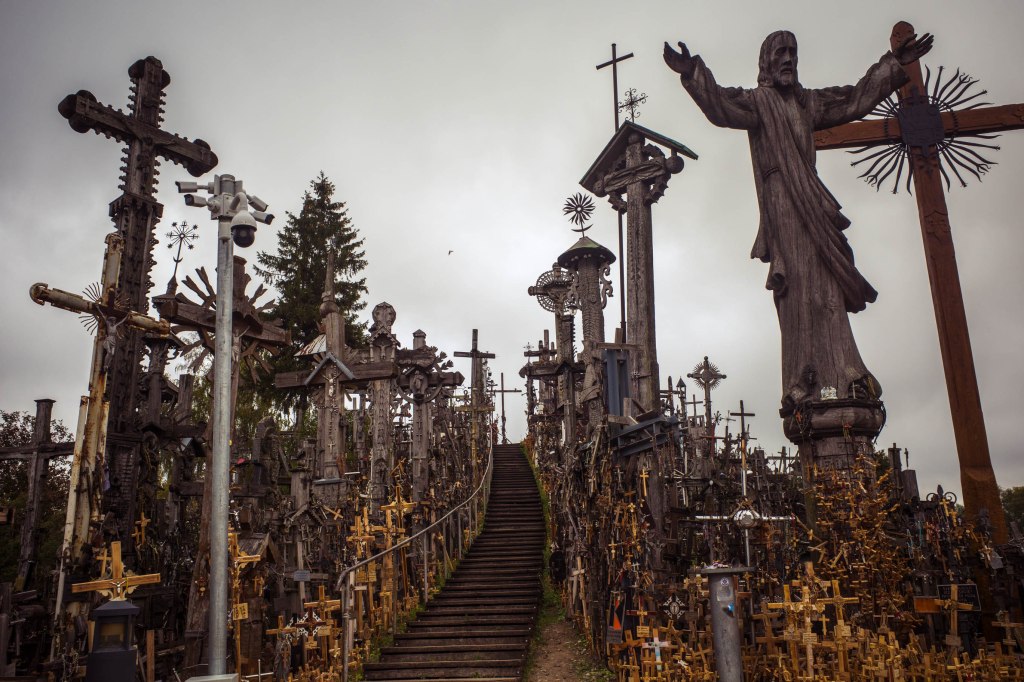
No one knows for sure when people first started placing crosses on this hill, but it’s been happening for around 200 years or so. The original reasons are murky as well, but during the Soviet occupation when the Soviets removed crosses from the hill on at least three separate occasions, placing a cross on the hill became a symbol of Lithuanian identity and a form of protest against the occupiers. Following the collapse of the Soviet Union, no one has removed crosses from the hill, and some estimates put the number of t-shaped objects at over one hundred thousand. It’s really impossible to imagine until you see it.
I arrived fairly early on a grey day, and so I had the hill to myself while I was there. It was a very eerie place. The only sound was the rustling of rosary beads against the crosses over which they were draped. Crosses bristle from every possible inch of the hill and its base. The concentration increases as you climb nearer the top of the hill. Some crosses are massive, beautiful, carved sculptures. Some are small, simple affairs. Some bear plaques and were clearly placed to commemorate something of great import. Some were purchased from the stalls in the parking lot. Near the summit of the hill (it’s really more of a lump to be honest), people have given up on even placing their crosses in the ground and there are piles of small crosses built up around the bases of the large ones. Somewhere someone has hidden a device that is quietly playing a recording of someone speaking. The crosses actually cover two small hills. As I summit the first I discover the second. As I summit the second I discover a field of sheep. The sheep notice me and come to investigate, their baaing finally breaking the spooky near silence of the hill.
Then I caught the bus back to town, and hopped on a train to Klaipeda. For although expressions of christian faith on the Hill of Crosses helped Lithuanians assert their identity during Soviet times, there are traditions here which long predate the arrival of Christianity. If I’m not mistaken, the Baltic area was the last in Europe to convert to Christianity, with some nice friendly crusades to ease the process. The Hill of Witches has been a site for midsummer celebrations, and also contains about 80 wooden carvings spread throughout the forest. To get there, I had to take a ferry from Klaipeda to the Curonian Spit. This is a strange, thin projection of land jutting into the Baltic Sea. Half of the spit is in Lithuania, and half is in Russia. “Russia?” you ask, “surely Russia is on the other side of Lithuania”. Well, most of Russia is, but there is a little exclave between Lithuania and Poland named Kaliningrad, and that is where the Curonian Spit is.
I was quite excited to rent a bike and cycle along the spit to the town of Juodkrantė to visit the Hill of Witches. It would be a lovely ride through the forest, and then I could bike elsewhere on the spit and visit the sand dunes and the beaches. However, when I set out on my journey the rain was absolutely pouring down and I decided that the bus to Juodkrantė looked rather pleasant. The rain did let off a bit, but it was still not a day for biking. Walking was just about fine.
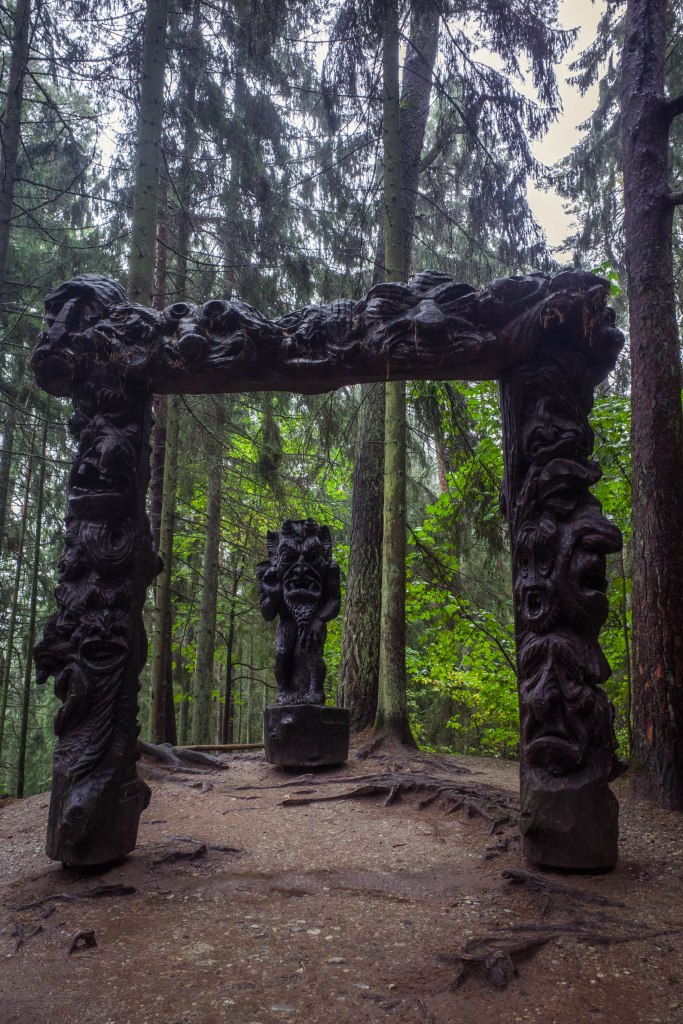
The Hill is a path through the forest. Deep dark woods would be an apt description. The rain adds to the atmosphere. Every twenty or thirty feet is a carving or two, most of them taller than me. I wish I knew some Lithuanian folklore so that I could identify the characters or the scenes depicted. Some are witches, some are demons, some are human. This was a lovely walk through the woods, and I would have enjoyed it even without the carvings. I only saw a couple other people, and was alone for most of my walk, but it never had the eerie feeling of the Hill of Crosses.
Although the rain added to the experience while walking through the forest, it made it quite difficult to see the rest of the Curonian Spit. I can only imagine what an idyllic place it is in the summer. This is somewhere that I will absolutely have to return to in the future, probably to take in a midsummer festival at the Hill of Witches.
Click for photos of:
 And whither then?