I arrived in Riga on the ferry from Stockholm, with approximately 5 hours to see the sights before I shipped off back to Sweden on day 2 of the Waves of Darkness on the Baltic Sea music festival (a post about that to come).
Five hours to see a city is far from ideal of course, but thankfully the main sights in Riga are all within a pleasant walking distance from the ferry terminal.
First things first. In Latvia, ‘sveiki’ means hello, and ‘paldies’ is thank you. Latvian and Lithuanian are two of the oldest languages in the Indo-European language family. This means that linguists believe them to be the closest to the common root language from which most of the languages in Europe, India, and Iran have evolved. Because of this I noticed many words which appeared similar to English or French, however there were just as many which, like ‘sveiki’, didn’t seem to have any relation to languages I know.
Anyhow, Riga is beautiful. It was overcast and slightly rainy while I was there, but I didn’t mind in the slightest. I started with a walk to a slightly out of the way ‘Soviet-style’ restaurant for lunch. The interior felt like a throwback to the 60s, but in a chic, hip way like we might have in North America, so I don’t feel like it was modelled after the sorts of places that working class Latvians would have eaten during Soviet times. I ate a pork cutlet with fries, it was very simple and plain, but it sure hit the spot. I also tried the famous Riga Black Balsam, which is a herbal liqueur that is black. It tastes just as potent as the description suggests.
Riga is renowned for having the largest collection of art nouveau architecture in the world. I couldn’t define art nouveau for you, but it’s from the turn of the century and it’s very nice. I took a lot of photographs of it so that I don’t have to describe it (they’re at the end).
There is also a top notch old town in Riga (there will be many an ‘old town’ throughout my journey, something about Europe and history I guess…). In Stockholm the old town was incredibly touristy, with the bottom floors of every beautiful old building full of souvenir shops and cafes. In Riga’s old town it seemed like only every second shop or so was in your face tourist-land. Of course this is because Riga is a smaller and less popular destination than Stockholm, but it really improves the experience. The art nouveau district is just normal residential streets, poor residents.
I visited my first ever Orthodox cathedral. Wow. It made Catholic cathedrals look plain in comparison. Photography was not allowed inside, so I will endeavour to paint a picture with words. Upon entering the air is redolent of incense. Every bit of wall is painted with designs and images. Gold and light blue dominate. All around the walls are icons, images of saints wrought in gold and silver, each with their own candle holder so worshippers can light candles at whichever icon they prefer. Opulent and dazzling probably describe it best.
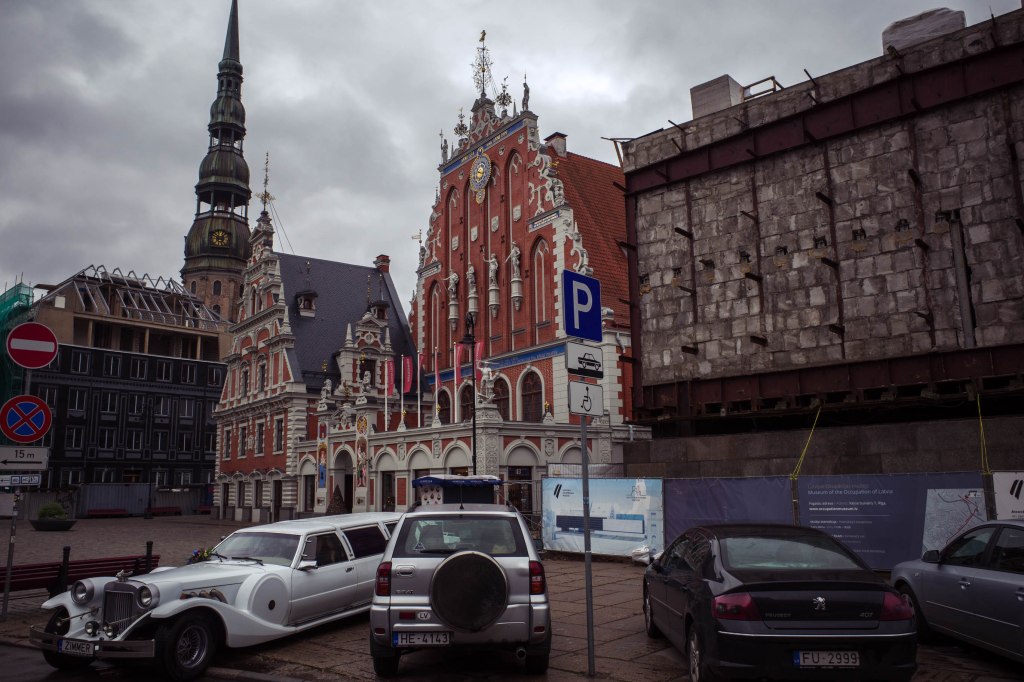
One of the biggest attractions in the old town is The House of the Black Heads. This was the home of the travelling merchant guild known as the Black Heads. Their symbol was St. Maurice, a North African, hence the name. It was destroyed in WWII and rebuilt in 1999, but you can still visit the original cellars.
Riga was excellent. I’ll be back in Latvia in a few weeks after I’ve been to Finland and Estonia, and I will gladly spend more time in Riga, although I also want to see more of Latvia.
 And whither then?